

0-6 Months: Foundations of Co-Regulation


Infancy: Birth to 6 Months, Foundations of Co-Regulation
Roots of Developmental Trauma · Infancy, Part 1
In the first year of life, your nervous system depended completely on the people around you. Every soothed cry and steady presence taught your body what safety feels like, long before you had words for any of it. The first year unfolds in two parts: birth to six months, when co-regulation lays the foundation, and six to twelve months, when attachment consolidates.
At a glance
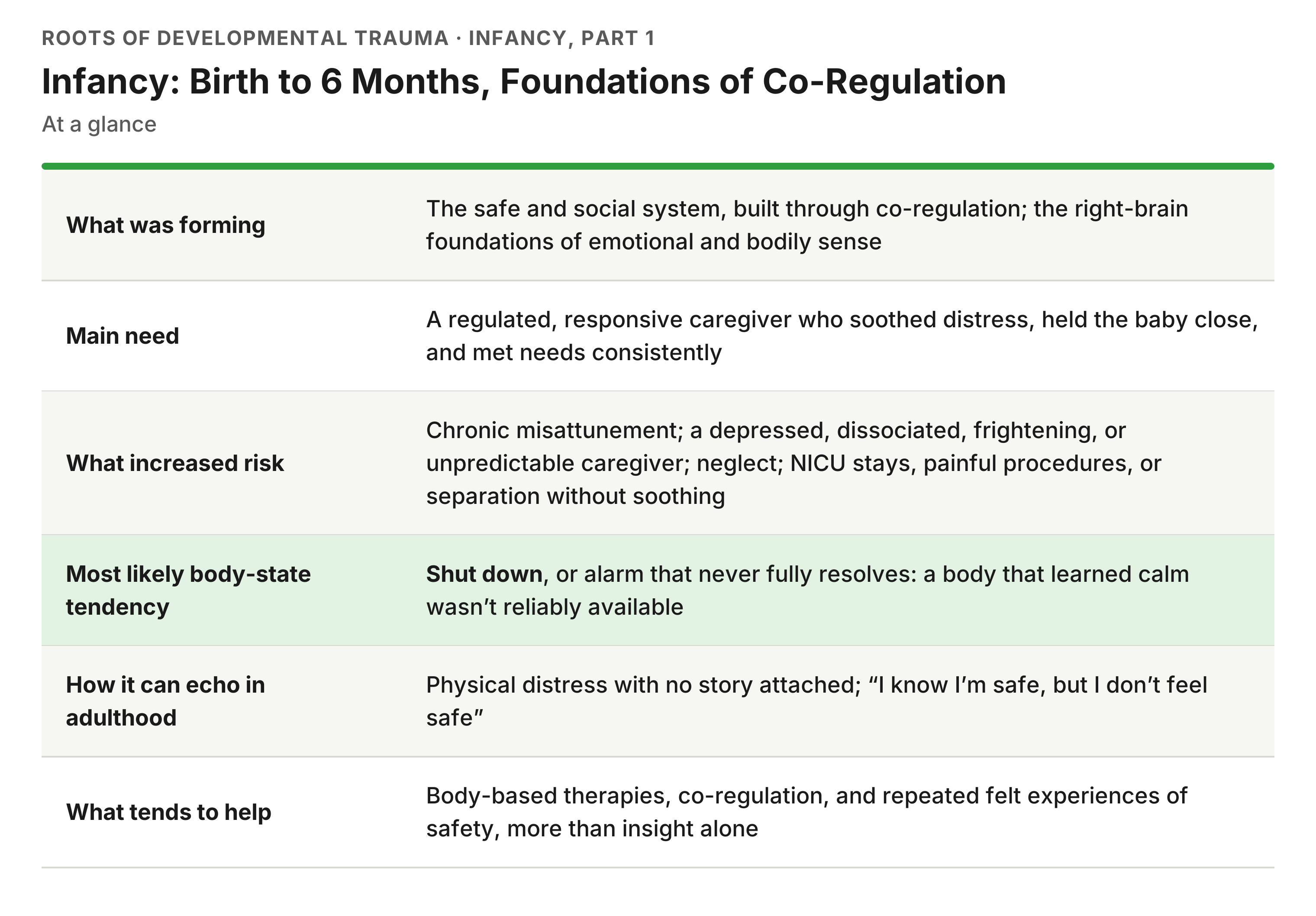
What was forming
A newborn arrives with a nervous system that is ready to survive, but not yet ready to feel safe on its own. Over the first six months, the systems for connection come online, and they come online through relationship.
The first month: survival mode
In polyvagal terms, the newborn nervous system relies heavily on its oldest branch, the shut down system. This branch governs digestion and heart rate and supports the freeze response. The safe and social system is present but immature; its nerve pathways are still being insulated with myelin, a process that continues rapidly through the first year.
Behavior in these weeks is largely reflexive: rooting, sucking, grasping, and the startle (Moro) reflex. Yet even now the newborn is not a blank slate. Neuroception is already biased toward the familiar. Newborns orient to their mother's voice, which they heard in the womb, and they can recognize her smell within days. Being held against a caregiver's body steadies a newborn's heart rate, breathing, and temperature.
Crying is a newborn's main signal, and it typically increases over the first weeks, often peaking around six weeks before gradually easing. Responding to crying doesn't "spoil" a baby. It is how the baby learns that distress leads to relief.
One to three months: the social engagement system wakes up
Through thousands of moments of co-regulation, the safe and social system begins to mature. Signs of this include:
- The social smile, usually emerging around six to eight weeks: a smile directed at a face, not just a reflex
- Mutual gaze: the baby holds eye contact and seeks out faces
- Cooing and turn-taking: baby and caregiver begin to "converse" with sounds and expressions
Researchers at Harvard's Center on the Developing Child call these exchanges serve and return. The baby "serves" with a coo, a look, or a cry, and the caregiver "returns" with a response. Each exchange builds neural connections. At the same time, the alarm system begins to differentiate. Instead of one undifferentiated wail, the baby's distress becomes more specific, and the baby starts to anticipate comfort.
Three to six months: the right brain takes shape
By three to six months, babies are remarkably social. They laugh, mirror expressions, and protest when a caregiver stops responding. Psychologist Allan Schore has described how the right hemisphere of the brain, which specializes in emotional, social, and bodily information, is in a period of especially rapid, experience-dependent growth during infancy.
The baby's brain is learning from the caregiver's face, voice, touch, and rhythm, largely through right-brain-to-right-brain communication. The quality of caregiving is shaping the child's sense of safety, from the body up.
This is also the age at which Ed Tronick's Still Face experiment, described in the introduction to this series, was first conducted. Even very young babies notice immediately when a caregiver's face goes blank, and try hard to restore connection.
Why this window matters
Co-regulation is the only mechanism
A young infant has essentially no capacity for self-regulation. A baby can't calm their own heart rate, slow their own breathing, or talk themselves down from distress. The caregiver's own regulated nervous system is the infant's regulation strategy.
Co-regulation, then, isn't a nice bonus in these months. It's the only mechanism available. When a caregiver picks up a crying baby, holds them close, and sways, the baby's body literally synchronizes with the caregiver's: heart rhythms, breathing, and stress hormones begin to align. A calm adult lends calm. A distressed or absent adult can't.
Learning safety from the body up
In this window, the baby can't think, reason, or remember in any explicit way. Everything is learned through the body. Repeated experiences of being soothed, fed when hungry, held when frightened, and met with a warm face build an implicit, body-level sense: the world is safe, and when it isn't, someone will help.
When care is consistently misattuned, the lesson is different, and it is recorded the same way: as a felt sense in the body and emotions, not as a memory or a thought. The infant is learning what safety feels like, or what its absence feels like, before cognition and logic are available to make sense of it.
Small, ordinary moments add up
No caregiver is perfectly attuned, and babies don't need perfection. What shapes the nervous system is the overall pattern: whether, most of the time, distress leads to comfort, and whether the inevitable mismatches are followed by reconnection.
What increased risk looked like
Risk in this window rarely comes from a single dramatic event. Much more often, it comes from what was missing, consistently, during a period when the baby had no way to cope alone.
A difficult start
- A difficult delivery or medical complications for mother or baby
- NICU stays, especially with limited opportunities for holding and skin-to-skin contact
- Early separation from the primary caregiver for any reason
- Painful medical procedures without adequate soothing
These experiences can disrupt the earliest window for skin-to-skin regulation and bonding. Modern NICUs increasingly encourage kangaroo care (skin-to-skin holding), partly because research has found lasting benefits for premature babies' stress regulation.
Chronic misattunement
The most powerful risk factor in this window is a caregiving pattern, not a single event. This includes a caregiver who was:
- Depressed: present in body but flat, slow to respond, or emotionally unavailable
- Dissociated: physically there but "gone" inside, often because of their own trauma
- Frightening: harsh, rough, or angry in response to the baby's needs
- Unpredictable: warm one moment and absent or overwhelmed the next
Neglect and inconsistency
- Inconsistent responses to hunger, discomfort, or distress
- Long periods left alone or crying without comfort
- Extended or repeated separations without a consistent substitute caregiver
- Multiple changing caregivers, as can happen in some childcare, foster, or institutional settings
A word about postpartum depression
Postpartum depression is common, affecting roughly one in seven mothers, and fathers can experience it too. It is a medical condition, not a failure of love. Many parents with postpartum depression love their babies deeply but find it hard to respond with the energy and warmth they want to give. When it goes untreated, which historically was often the case, a baby may experience long stretches of flat or delayed responses. As with every stage in this series, understanding this is about compassion, not blame.
Echoes in adulthood
Because this period is stored implicitly, before language and largely through the body and right brain, disruption here rarely shows up as a memory. It shows up as sensation and state.
"I know I'm safe, but I don't feel safe"
This is one of the clearest signatures of this window. A person can understand, logically, that nothing is wrong, and still feel a deep, bodily sense of danger, emptiness, or dread. Logical reassurance doesn't reach it, because the pattern was never stored in the part of the brain that logic speaks to.
It might look like:
- Physical distress with no clear story attached: a tight chest, a pit in the stomach, a sense of falling or drowning
- Panic or anxiety that doesn't respond to reasoning
- A baseline of numbness, flatness, or feeling "not quite here"
- Difficulty being soothed by others, or difficulty knowing what would help
- Feeling deeply alone even when surrounded by people
- Strong reactions to being left, ignored, or not responded to, such as an unanswered text
- Trouble sensing internal cues such as hunger, fatigue, or emotion
Where this sits on the ladder
A baby whose cries go unanswered often ends up in shut down. When calling for help doesn't work, the nervous system conserves energy by going quiet. In adulthood, that can look like a tendency to collapse, go numb, or feel hopeless under stress. Others carry the opposite echo: an alarm that rises quickly and never quite settles, because calm was never reliably available to return to. Many people experience both.
Why talk alone may not be enough
This is often where body-based approaches have more traction than talk therapy alone, precisely because the material was never encoded as a story to begin with. Understanding the pattern still matters; it relieves shame and gives you language. But changing it usually requires new experiences the body can feel.
What helps
Then: what babies needed
What protected babies most in this window:
- Skin-to-skin contact and being held close, especially in the earliest weeks
- Prompt, consistent responses to crying, hunger, and discomfort
- Serve and return: warm faces, eye contact, and back-and-forth sounds
- Rhythm and predictability: rocking, feeding, and sleep routines that the body can anticipate
- Soothing during medical care, such as holding, swaddling, feeding, or a familiar voice
- A supported caregiver: a parent who had rest, help, and treatment for postpartum depression or anxiety if needed
The good news is that babies are remarkably responsive to repair. When a caregiver who struggled early on gets support, the relationship can recover, and the baby's nervous system with it.
Now: healing as an adult
Because this material lives in the body, it tends to respond to approaches that work with the body directly and offer safe relationship in real time:
- Somatic Experiencing, which helps the body gently complete stuck stress responses
- Sensorimotor Psychotherapy, which works with body sensations, posture, and movement alongside emotion
- Polyvagal-informed therapy, which helps you map your states and build pathways back to safe and social
- EMDR, adapted for early and pre-verbal material by a trained clinician
- Co-regulation in the therapy relationship: the steady presence of a therapist who notices your state and helps you settle
Between sessions, practices that help the body feel what safety is like include:
- Slow breathing with a long exhale
- Rhythmic movement, such as rocking, walking, or swinging
- Warmth and weight, such as a weighted blanket, a warm bath, or a hand on your chest
- Gentle humming or singing, which engages the same muscles of the face and throat involved in social connection
- Time with safe people and safe animals
- Learning to notice small moments of ease and stay with them a little longer
The aim is not to argue your body out of feeling unsafe. It is to give your body enough new experiences of safety that it begins, gradually, to believe them.
In practice: a composite vignette
This vignette is a composite drawn from common clinical patterns. It does not describe any real person.
Priya, 29, can know logically that she is safe during a panic attack and still feel like she is drowning. Her attacks often come at night, or when she is alone, or after a friend takes a long time to text back. Friends try to reassure her, and she wants to believe them, but the words don't reach the place where the fear lives. Afterward, she feels exhausted and embarrassed.
Priya was born six weeks premature and spent three weeks in the NICU, with limited opportunities for skin-to-skin contact. That was followed by a difficult stretch at home while her mother struggled with postpartum depression that went untreated for most of Priya's first year. Priya has no memory of any of this. But her body still responds to distress as though calm has never been reliably available.
In therapy, Priya and her therapist stopped trying to argue with the panic. Instead, they worked on helping her body experience settling. They practiced noticing the first signs of alarm, slowing her exhale, and placing a hand on her chest. In session, her therapist's calm, steady voice became an anchor she could borrow. Over months, Priya began to recognize that the drowning feeling was an old body memory, not a present-day danger. Her panic attacks became shorter and less frequent, and she found she could ask friends for comfort without feeling ashamed.
Priya also talked with her mother, who cried when she learned how much her early depression may have mattered. Their conversation became a repair of its own.
Questions for reflection
Most people know little about their first six months. If you choose to ask family members, do so only if it feels safe. Go slowly, and consider exploring these questions with your therapist.
- What do you know about your birth and your first months? Were there medical complications, separations, or hospital stays?
- What was life like for your caregivers then? Were they supported, rested, grieving, depressed, or overwhelmed?
- Do you ever experience a sense of unsafety in your body that doesn't respond to logic? What does it feel like, and where do you feel it?
- When you're distressed, do you tend toward alarm (racing, panicking) or shut down (numb, flat, collapsed)?
- What helps your body settle? Think about touch, rhythm, warmth, sound, and the presence of certain people.
- What would it be like to offer yourself the kind of care a baby needs: warmth, patience, and comfort without conditions?
Sources
- Center on the Developing Child at Harvard University. Serve and Return and Brain Architecture resources. developingchild.harvard.edu
- Feldman, R. (2012). Bio-behavioral synchrony: A model for integrating biological and microsocial behavioral processes in the study of parenting. Parenting: Science and Practice, 12(2–3), 154–164.
- Feldman, R., Rosenthal, Z., & Eidelman, A. I. (2014). Maternal-preterm skin-to-skin contact enhances child physiologic organization and cognitive control across the first 10 years of life. Biological Psychiatry, 75(1), 56–64.
- Field, T. (2010). Postpartum depression effects on early interactions, parenting, and safety practices: A review. Infant Behavior and Development, 33(1), 1–6.
- Porges, S. W. (2011). The Polyvagal Theory. W. W. Norton.
- Schore, A. N. (2001). Effects of a secure attachment relationship on right brain development, affect regulation, and infant mental health. Infant Mental Health Journal, 22(1–2), 7–66.
- Tronick, E., Als, H., Adamson, L., Wise, S., & Brazelton, T. B. (1978). The infant's response to entrapment between contradictory messages in face-to-face interaction. Journal of the American Academy of Child Psychiatry, 17(1), 1–13.
- van der Kolk, B. (2014). The Body Keeps the Score. Viking.

Trending Blogs


Kelly has helped me get 'unstuck' many times. I will come to see her when I just can't seem to figure 'this last bit out', and she will take me over the finish line. She is empathetic, and... Read More
After moving states & having to leave my therapist of 6 years, I cannot express enough how fortunate I am to have found someone as incredible as Kelly. From the very first session, it... Read More
I've known Kelly for several years, so when I decided to work through some issues, she was the number one choice and only therapist I knew I could trust. Talking with Kelly is easy, like... Read More
I have been seeing Kelly for individual therapy for the past two years and could not recommend her enough! She is very insightful and has helped me navigate many difficult periods in my... Read More
Kelly has exceeded my expectations and then some! She has been an incredible resource for me, helping navigate any situation I bring to her. She is extremely thoughtful in her approach,... Read More
Kelly is an incredible, empathetic, knowledgeable therapist. She creates a safe space for her clients. I have been a client of hers for 2 years now and couldn’t ask for a better therapist.... Read More
Everyone needs a Kelly. My husband and I turned to her during a time of complete crisis, and the transformation we experienced through her guidance has been life-changing. Kelly has an incredible... Read More
Looking for Premarital Counseling? Go here. Kelly was incredible.My fiancé and I took Kelly's premarital counseling program and were blown away with how well she understood our relationship... Read More