

6-12 Months: Attachment Consolidation

Infancy: 6–12 Months, Attachment Consolidation
Roots of Developmental Trauma
Between six and twelve months, a baby's bond with their caregivers becomes organized and specific. The infant now knows who their people are, prefers them, and protests when they leave. Underneath that shift, the brain is wiring itself at a remarkable pace, making this one of the most experience-dependent windows of the entire lifespan.
At a glance
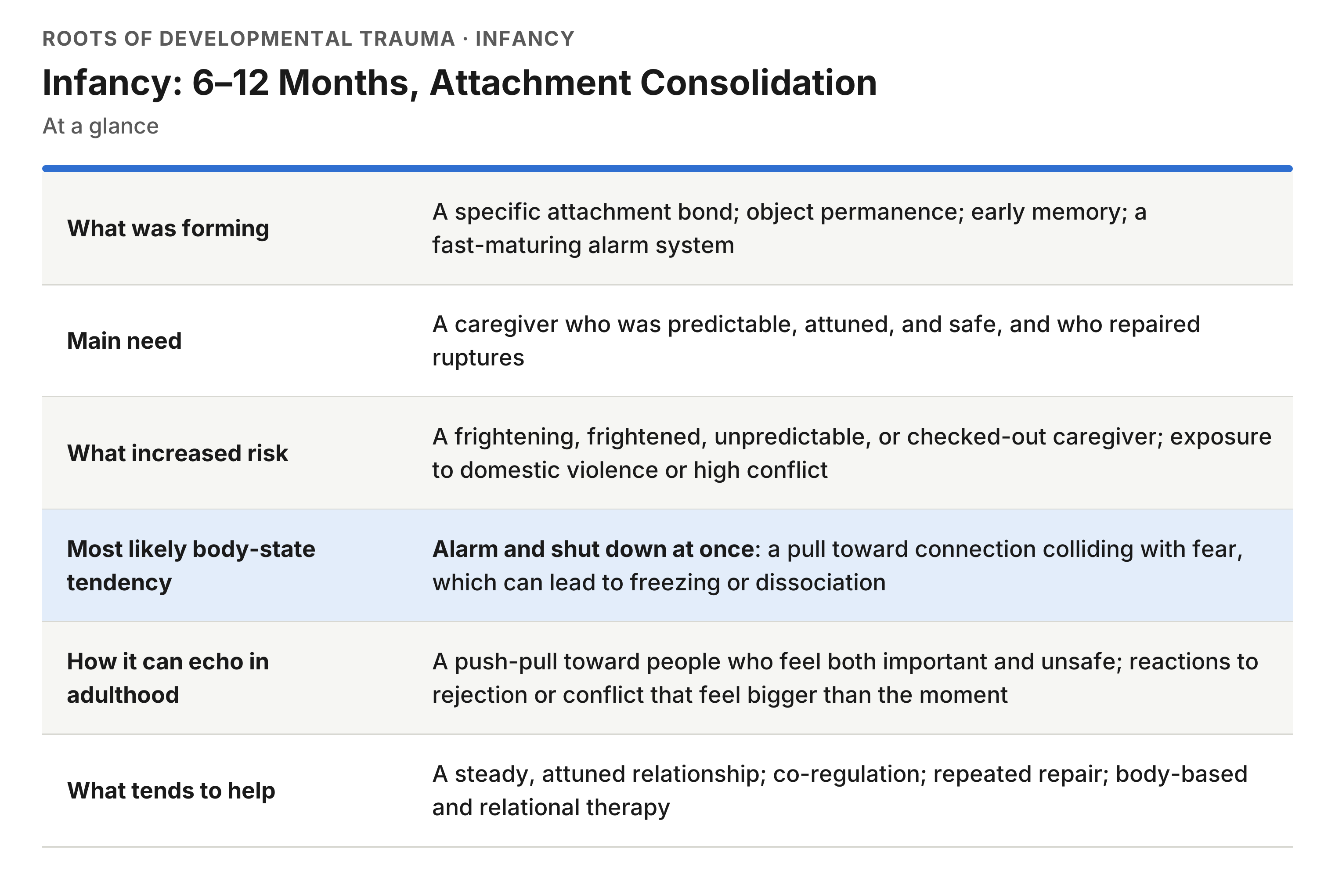
What was forming
A specific bond
In the first months of life, babies accept comfort from almost anyone who offers it. Somewhere around six to nine months, that changes. Attachment becomes specific: the baby develops a clear preference for one or a few familiar people, and an internal ranking forms, sometimes called an attachment hierarchy. The infant turns to their primary person first when tired, hurt, or afraid.
With this bond come two new reactions, and both are healthy signs:
- Stranger anxiety: wariness or distress around unfamiliar people, often emerging around six to nine months
- Separation distress: protest when a caregiver leaves, typically building through the end of the first year and into the second
These reactions are evidence of attachment, not signs that something is wrong. A baby who protests when Mom leaves the room is showing that Mom matters.
Out of sight, but not out of mind
During this window, object permanence develops: the understanding that people and things still exist when they can't be seen. This is part of why separation becomes upsetting. The baby now knows the caregiver is somewhere else, and can miss them.
The beginnings of memory
Until now, almost everything a baby learns is stored as implicit memory: body-based expectations, feelings, and reflexes. Between six and twelve months, the first glimmers of more explicit memory begin to appear. Babies can now imitate something they saw the day before, or search for a toy where they last saw it hidden. Still, the hippocampus that supports lasting, recallable memory is years from maturity. What a baby learns about relationships in this window is still recorded mostly in the body, not in a story.
A brain under construction
The number of connections between brain cells, called synapses, rises steeply through infancy toward a peak in early childhood. Later, the brain will prune away connections that aren't used and strengthen the ones that are. This "use it or lose it" process means that what a baby experiences repeatedly, whether comfort or fear, responsiveness or absence, is literally built into the brain's architecture.
Why this window matters
A loud alarm with no off switch
The brain doesn't develop all at once. The amygdala, the brain's threat-detection center, is active and responsive very early. The prefrontal cortex, the region that will eventually help calm the amygdala down, is one of the slowest parts of the brain to mature and won't be fully developed until the mid-twenties.
This means an infant has a fully "loud" alarm system and essentially no built-in "quiet down" system. A baby cannot soothe themselves out of fear. They depend completely on co-regulation: a caregiver's calm voice, steady arms, and attuned presence to bring their nervous system back to safe and social.
Research suggests that a caregiver's presence does more than comfort a baby in the moment. It acts as an external regulator, effectively standing in for the prefrontal cortex the baby doesn't yet have. Over thousands of repetitions, that borrowed calm helps build the baby's own capacity to settle.
Rupture and repair, thousands of times
This is also the window in which the question at the heart of this series becomes urgent: Can I count on this person to help me feel okay again? Every hard moment followed by comfort teaches the answer "yes." Every hard moment left unanswered, or made worse, teaches something else.
By around twelve months, researchers can observe how a baby has organized their attachment strategy. They usually do this with a standardized observation called the Strange Situation, developed by Mary Ainsworth, in which a baby is briefly separated from and reunited with their caregiver. What matters most is not how upset the baby gets when the caregiver leaves, but what happens at the reunion.
Four attachment patterns
Each pattern is an intelligent adaptation to the caregiving a baby received. None is a flaw in the baby.
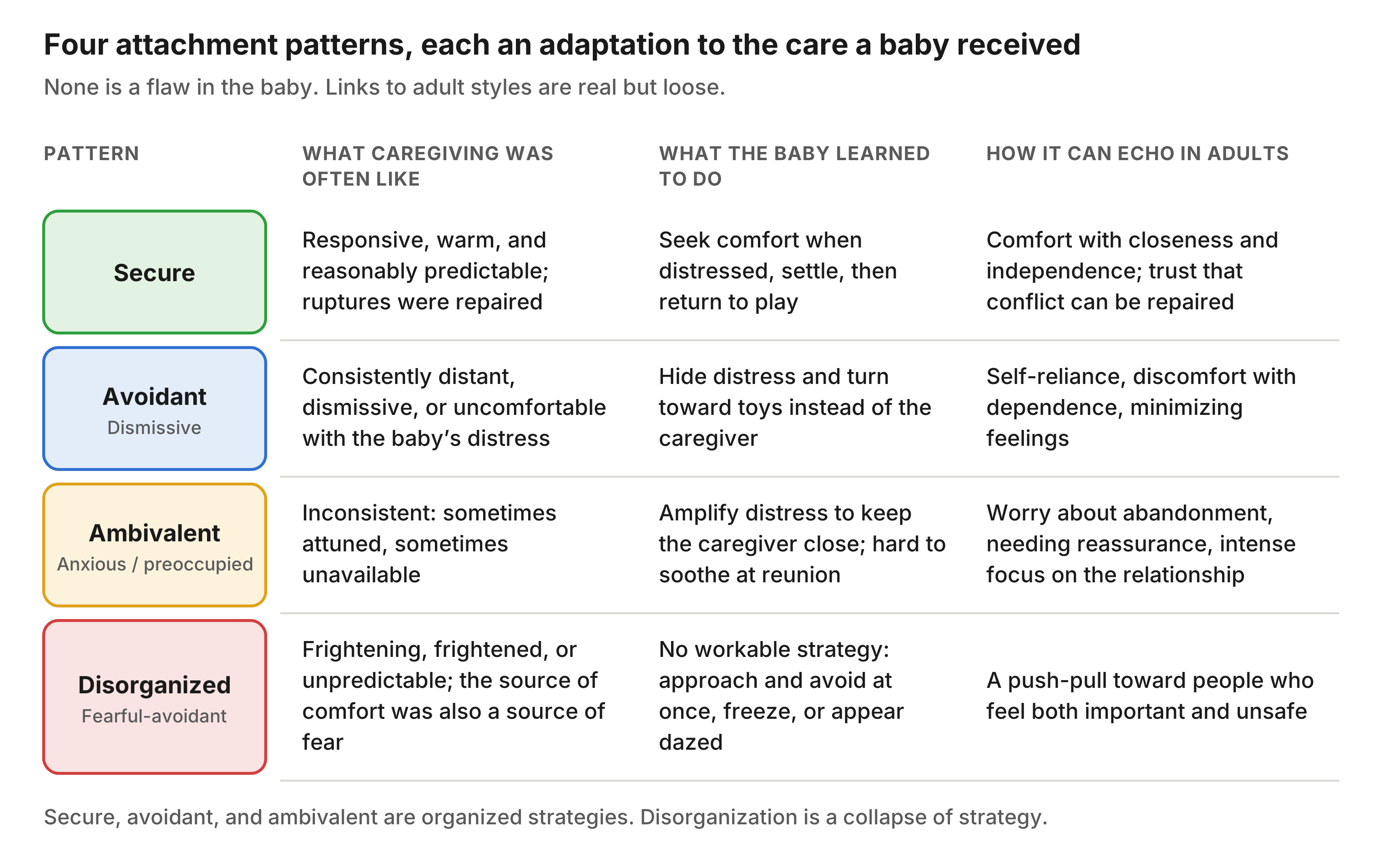
The first three are called organized patterns. Even avoidant and ambivalent babies have a consistent strategy that works with the caregiver they have. Disorganized attachment is different: it reflects a collapse of strategy, because no strategy can work. In low-risk families, roughly one in seven babies show disorganized attachment. The rate is much higher in families affected by maltreatment.
The links between infant patterns and adult attachment styles are real but loose. Later relationships, life experiences, and therapy all shape how attachment looks in adulthood.
What increased risk looked like
Fright without solution
This is the classic window for the formation of disorganized attachment. Researchers Mary Main and Erik Hesse described its core as fright without solution.
When a baby is frightened, two instincts fire at once: to get away from the danger, and to run toward the attachment figure for safety. Normally, both instincts point in the same direction, toward the caregiver. But when the caregiver is the source of fear, the two instincts collide. The baby is caught needing to run toward the very person who frightens them. There is no solution, so the nervous system may do the only thing left: freeze, go blank, or dissociate.
In the language of this series, the baby is in alarm and shut down at the same time: mobilized to seek safety, and immobilized because safety and danger are the same person.
What can create this bind
It doesn't take intentional harm. A caregiver can be frightening, or frightened, in many ways:
- Anger, yelling, rough handling, or abuse
- Unpredictable shifts in mood, such as from untreated mental illness or substance use
- A caregiver who is themselves terrified or dissociated, often because of their own unresolved trauma or loss
- Sudden withdrawal, going blank, or appearing "gone" in the middle of an interaction
- Long or repeated separations without a consistent substitute caregiver
- Severe depression that leaves a caregiver emotionally absent
Many of these caregivers love their babies deeply. A parent carrying unresolved trauma can unknowingly pass on fear through their face, voice, and body, even while trying their best.
Witnessing violence and conflict
Babies are not too young to be affected by what happens around them. Infants exposed to domestic violence can show trauma symptoms such as sleep disruption, heightened startle, and distress at loud voices. One study found that the brains of sleeping infants from high-conflict homes reacted more strongly to angry voices. Even when a baby is not directly harmed, watching a caregiver be frightened or hurt, or sensing a home filled with tension, registers in the nervous system.
When normal reactions change
Trauma in this window can change a baby's normal stranger and separation reactions in either direction. Some babies become intensely and inconsolably distressed. Others seem unusually unbothered: they go to strangers without hesitation, or don't react when a caregiver leaves or returns. Both can signal insecurity rather than security.
Echoes in adulthood
The fright-without-solution bind from this window often echoes in adult relationships as an inner push-pull toward people who feel both important and unsafe. This is sometimes described as fearful-avoidant or disorganized attachment. It can look like:
- Wanting closeness intensely, then feeling trapped or suspicious once it arrives
- Pulling someone in, then pushing them away, sometimes in the same conversation
- Picking fights or ending relationships just as they start to feel serious
- Feeling drawn to partners who are unpredictable, and bored or uneasy with partners who are steady
- Reactions to perceived rejection or conflict that feel far bigger than the moment
- Going blank, numb, or "far away" during conflict with someone close
- Difficulty trusting your own perceptions in relationships
Why the reactions feel so big
These reactions can feel disproportionate to the present-day situation, because the alarm system driving them was wired "loud," with no off switch, before there was language to make sense of it. In the language of this series, closeness itself can trigger alarm, and conflict can tip a person straight past alarm into shutdown. The window of tolerance in close relationships may be especially narrow.
Because this was learned through implicit memory, there's often no story attached. A person may simply know that intimacy feels dangerous, without knowing why.
Dissociation
Research has linked disorganized attachment in infancy with a greater tendency toward dissociation later in life. This makes sense. When a baby has no way to flee or to find comfort, "leaving" internally is the only escape available. As an adult, that might show up as spacing out, feeling unreal, losing time, or feeling disconnected from your body under stress.
A note of hope
This is a pattern, not a destiny. Many people with disorganized beginnings go on to form secure, loving relationships, especially when they have the chance to experience a different kind of relationship.
What helps
Then: what babies needed
What protected babies most in this window was a caregiver who was:
- Predictable: responding in similar ways from day to day, so the baby could anticipate comfort
- Attuned: noticing and responding to the baby's cues, not perfectly but often enough
- Safe: a source of comfort, not fear
- Repairing: returning to reconnect after hard moments, mistakes, or separations
- Supported: caregivers who themselves had help, rest, and room to process their own history
Research is encouraging here. A parent's own trauma doesn't automatically pass to their child. What matters most is whether the parent has been able to make sense of their own history. Parents who have done that work are far more likely to raise securely attached children, regardless of what they went through.
Now: healing as an adult
Reading about a pattern is a starting point. Lasting change tends to come from something reading alone can't provide: the felt experience of a steady, attuned relationship.
A therapist can offer real-time co-regulation and repeated repair after rupture, the very things that may have been missing early in life. For someone with disorganized roots, simply experiencing a relationship where closeness doesn't lead to fear, and where conflict leads to repair rather than danger, can gradually reshape the nervous system's expectations. That is often what actually shifts the baseline, not just understanding it intellectually.
Because this material is pre-verbal, it tends to respond better to body-based and relational work than to talk alone. Approaches that often help include:
- Attachment-focused therapy, where the therapeutic relationship itself is a central part of healing
- Body-based therapies such as Somatic Experiencing or Sensorimotor Psychotherapy, which help the body tolerate closeness and complete stuck stress responses
- Parts work such as Internal Family Systems, which can help with the push-pull between a part that longs for connection and a part that guards against it
- Emotionally Focused Therapy for couples, which helps partners understand and change the cycles that closeness and conflict set off
- Grounding skills for moments of shutdown or dissociation, such as naming what you see, feeling your feet on the floor, and orienting to the room
Go slowly
With disorganized patterns, closeness itself can feel threatening, and that includes closeness with a therapist. It's normal to feel a pull to quit therapy just as it starts to help. Naming that pull, rather than acting on it, can be one of the most important steps in the work.
Over time, many people develop earned secure attachment: a secure way of relating that grows out of reflection and healing relationships later in life.
In practice: a composite vignette
This vignette is a composite drawn from common clinical patterns. It does not describe any real person.
Marcus, 36, keeps ending relationships right when they start to feel serious. He wants closeness, then can't tolerate it once he has it. He grows suspicious of, or picks fights with, partners who are by all accounts steady and kind. Afterward, he feels relief, then loneliness, then shame. He has started to wonder whether he is simply incapable of love.
In therapy, Marcus described his father, who lived with untreated bipolar disorder. Some days his father was warm and playful. On others he was frightening and volatile, and there was no way for young Marcus to predict which father would walk through the door. The person who was supposed to be his safety was also, unpredictably, his fear. Marcus has no memories from his first year, but his mother later told him that his father's most severe episodes began shortly after he was born.
Understanding the fright-without-solution bind helped Marcus see his pattern differently. His urge to flee when a relationship deepened wasn't a sign that he couldn't love. It was an old alarm going off, one that had learned that closeness and danger arrive together.
The real work happened in the relationship with his therapist. Early on, Marcus canceled sessions whenever he felt he had shared too much. His therapist named the pattern gently and without judgment, and they talked about it together. When Marcus got angry about a missed phone call, his therapist acknowledged the mistake and repaired it. Over time, Marcus noticed something new: he could feel close to someone, disagree with them, and still be safe. He began practicing the same thing, slowly, in his dating life.
Questions for reflection
These questions touch on tender material. Go slowly, and consider exploring them with your therapist rather than alone. If you notice yourself going numb or far away while reading, pause and ground yourself before continuing.
- When someone becomes important to you, what happens in your body? Do you notice a pull closer, a pull away, or both?
- What do you know about your caregivers' emotional lives during your first year? Were they safe, overwhelmed, frightened, or absent?
- In conflict with someone close, do you tend to fight, flee, freeze, or go blank?
- Which of the four attachment patterns feels most familiar? Does it shift depending on the relationship?
- Who in your life has offered you a steady, predictable presence? What was it like to be around them?
- What would it feel like to experience closeness and conflict in the same relationship, and still be safe?
Sources
- Ainsworth, M. D. S., Blehar, M. C., Waters, E., & Wall, S. (1978). Patterns of Attachment: A Psychological Study of the Strange Situation. Erlbaum.
- Carlson, E. A. (1998). A prospective longitudinal study of attachment disorganization/disorientation. Child Development, 69(4), 1107–1128.
- Gee, D. G., et al. (2013). Early developmental emergence of human amygdala–prefrontal connectivity after maternal deprivation. Proceedings of the National Academy of Sciences, 110(39), 15638–15643.
- Graham, A. M., Fisher, P. A., & Pfeifer, J. H. (2013). What sleeping babies hear: A functional MRI study of interparental conflict and infants' emotion processing. Psychological Science, 24(5), 782–789.
- Huttenlocher, P. R., & Dabholkar, A. S. (1997). Regional differences in synaptogenesis in human cerebral cortex. Journal of Comparative Neurology, 387(2), 167–178.
- Liotti, G. (2004). Trauma, dissociation, and disorganized attachment: Three strands of a single braid. Psychotherapy: Theory, Research, Practice, Training, 41(4), 472–486.
- Main, M., & Hesse, E. (1990). Parents' unresolved traumatic experiences are related to infant disorganized attachment status. In M. T. Greenberg, D. Cicchetti, & E. M. Cummings (Eds.), Attachment in the Preschool Years.University of Chicago Press.
- Main, M., & Solomon, J. (1990). Procedures for identifying infants as disorganized/disoriented during the Ainsworth Strange Situation. In Attachment in the Preschool Years. University of Chicago Press.
- van IJzendoorn, M. H., Schuengel, C., & Bakermans-Kranenburg, M. J. (1999). Disorganized attachment in early childhood: Meta-analysis of precursors, concomitants, and sequelae. Development and Psychopathology, 11(2), 225–250.

Trending Blogs


Kelly has helped me get 'unstuck' many times. I will come to see her when I just can't seem to figure 'this last bit out', and she will take me over the finish line. She is empathetic, and... Read More
After moving states & having to leave my therapist of 6 years, I cannot express enough how fortunate I am to have found someone as incredible as Kelly. From the very first session, it... Read More
I've known Kelly for several years, so when I decided to work through some issues, she was the number one choice and only therapist I knew I could trust. Talking with Kelly is easy, like... Read More
I have been seeing Kelly for individual therapy for the past two years and could not recommend her enough! She is very insightful and has helped me navigate many difficult periods in my... Read More
Kelly has exceeded my expectations and then some! She has been an incredible resource for me, helping navigate any situation I bring to her. She is extremely thoughtful in her approach,... Read More
Kelly is an incredible, empathetic, knowledgeable therapist. She creates a safe space for her clients. I have been a client of hers for 2 years now and couldn’t ask for a better therapist.... Read More
Everyone needs a Kelly. My husband and I turned to her during a time of complete crisis, and the transformation we experienced through her guidance has been life-changing. Kelly has an incredible... Read More
Looking for Premarital Counseling? Go here. Kelly was incredible.My fiancé and I took Kelly's premarital counseling program and were blown away with how well she understood our relationship... Read More