

12-24 Months: Exploration & Rupture-Repair


12–24 Months: Exploration and Rupture-Repair
Roots of Developmental Trauma · Infancy, Part 3
From first steps to first stories, a toddler's growing independence meets an equally growing need for connection. This is where big feelings, small repairs, and the earliest sense of self all take shape.
At a glance
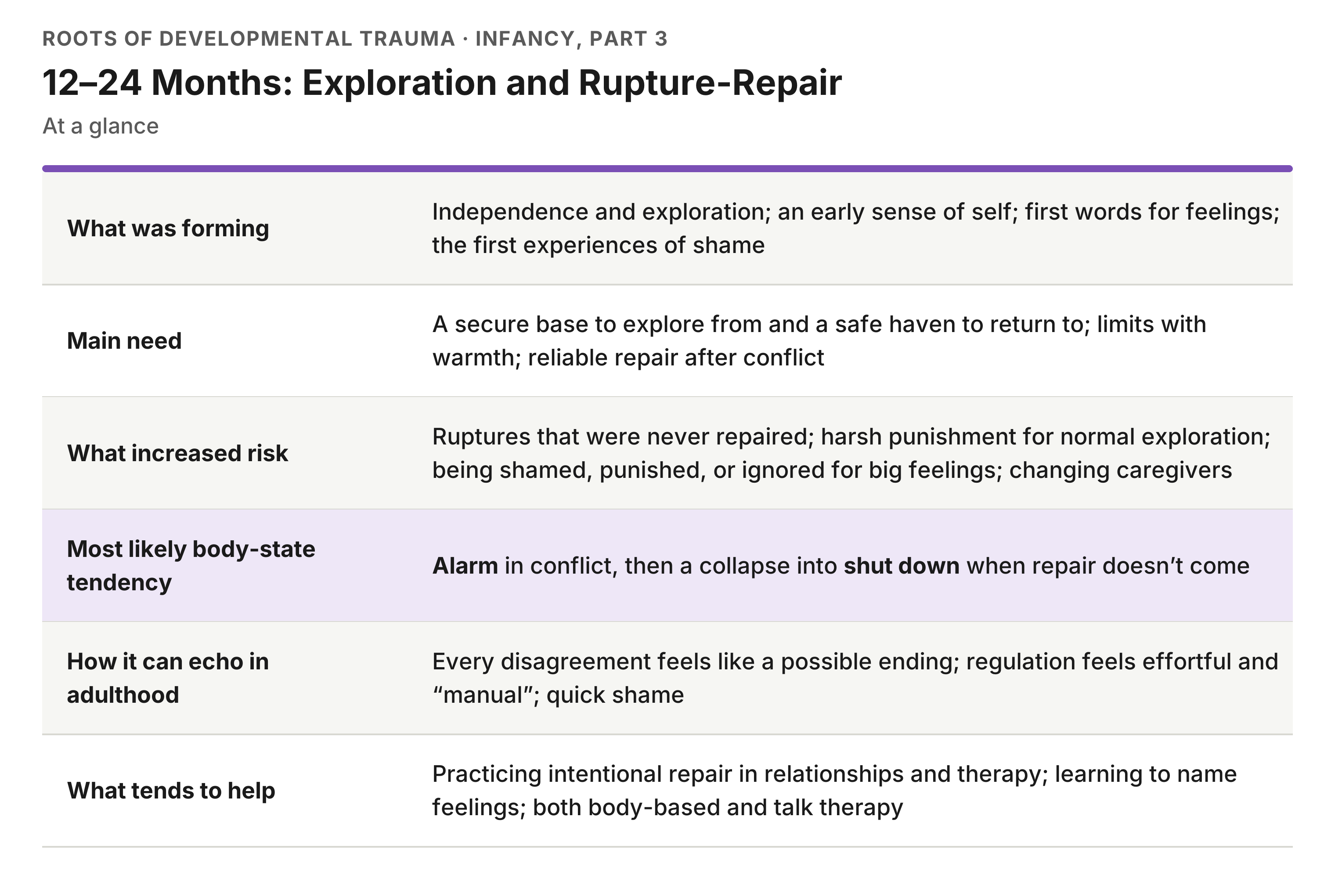
What was forming
Huge feelings, a tiny brake
Toddlers have enormous feelings and almost no ability to manage them yet. The alarm system is fully online, while the brain regions that support self-regulation, especially the prefrontal cortex, are among the slowest to mature. A toddler can feel furious, devastated, or terrified in an instant, with no internal brake to slow it down.
This is why tantrums are so common in this window. A tantrum is a sign of an overwhelmed nervous system, not a "bad" child or a manipulative one. In the language of this series, the toddler has tipped outside their window of tolerance and can't find their own way back. They still need a caregiver's calm to help them return.
Explore, then return
Now that they can walk, toddlers can move away from their caregivers for the first time, and they want to. They climb, open, touch, and test everything. But independence is frightening too. So toddlers swing back and forth: venturing out boldly, then rushing back for a hug, a look, or a lap, before heading out again.
Attachment researchers describe the caregiver's role in two parts:
- A secure base: someone the child can explore from, who watches with interest and encouragement
- A safe haven: someone the child can return to when frightened, hurt, or overwhelmed, who offers comfort without shame
A toddler who has both learns that independence and connection can coexist. They don't have to choose between being themselves and being loved.
An attachment pattern takes shape
By this age, a child's attachment pattern (secure, avoidant, ambivalent, or disorganized) is usually identifiable. Each reflects what attachment theorist John Bowlby called an internal working model: a set of body-level expectations, built since birth, about whether others will be there and whether one's needs are acceptable. (The previous post describes the four patterns in detail.)
First words for feelings
Language develops rapidly in the second year. Many toddlers go from a handful of words to hundreds. This opens a new door: for the first time, a child can begin to name internal states. But the capacity is very limited, and it depends almost entirely on a caregiver supplying the words: "You're so mad that the tower fell," or "You're scared of the loud noise." Psychiatrist Dan Siegel calls this "name it to tame it." Putting words to a feeling helps calm it, and toddlers learn this only when an adult does it with them, again and again.
The first sense of self, and the first shame
Around eighteen months, most toddlers begin to recognize themselves in a mirror. With this emerging sense of self comes a new family of emotions: embarrassment, pride, and shame. A toddler can now feel not only "something bad happened" but the beginnings of "I am bad."
Shame in small doses is a normal part of learning limits. When a caregiver says "No!" to a toddler reaching for a hot stove, the child may droop, look away, and collapse for a moment. That is shame, and it is a shut-down response. What matters is what comes next. When the caregiver reconnects ("That was scary. I didn't want you to get hurt. Come here"), the shame resolves and the child learns that a limit isn't the same as losing love. When reconnection doesn't come, the shame stays.
Why this window matters
Ruptures are normal; repair is what matters
Disagreements, frustrations, and mistakes are part of every relationship, and toddlerhood is full of them. Caregivers say no. They get tired, distracted, or short-tempered. Toddlers protest, melt down, and push limits. Even in healthy caregiver-child relationships, moments of mismatch are frequent.
These ruptures aren't harmful in themselves. In fact, they're useful. What builds trust and regulation is the repair: the caregiver returning to reconnect, comfort, or make things right. Each time this happens, the toddler learns three things at once:
- Big feelings are survivable.
- Connection can break and come back.
- I'm still loved, even when I'm upset or I've done something wrong.
How repair builds the brain
Self-regulation isn't something a child is born with or simply grows into. It is built from the outside in. Every time a caregiver helps a distressed toddler calm down, the child's brain gets a repetition of the path from alarm back to safety. Over thousands of repetitions, those pathways strengthen, and the child gradually becomes able to travel them alone.
This is the scaffolding for self-regulation. Without repair, the child doesn't get the repetitions their brain is trying to build.
What repair looks like with a toddler
Repair doesn't need to be elaborate. It might sound like:
- "I yelled, and that was scary. I'm sorry. I'm here now."
- "You were so upset. That was hard. Want a hug?"
- "I said no to the cookie, and you're really mad. It's okay to be mad. I'm still right here."
Repair also includes a caregiver's tone, face, and touch, which say we're okay long before a toddler understands the words.
What increased risk looked like
In this window, trauma is often the absence of repair, not the rupture itself. Normal ruptures, such as a caregiver's frustration, misattunement, or brief unavailability, are inevitable and even helpful, but only if they are reliably followed by reconnection.
Risk factors include:
- Ruptures that were never repaired: conflict followed by silence, withdrawal, or moving on as if nothing happened
- Harsh discipline for normal exploration: being hit, yelled at, or frightened for touching, climbing, or testing limits, which are the developmental work of this age
- Being punished or ignored during big emotions: tantrums met with anger, ridicule, isolation, or a cold shoulder
- Love withdrawn as punishment: affection that disappeared when the child misbehaved, sometimes for long periods
- Shaming: "What's wrong with you?" "Bad girl." "Stop crying or I'll give you something to cry about."
- Frequent changes in caregivers: moves, changing childcare, foster placements, or a parent who came and went
- A caregiver who couldn't tolerate the child's independence or neediness, or who punished one or the other
Each of these interferes with a toddler's growing trust that the relational world holds steady.
Where toxic shame begins
This window matters especially for shame. A toddler who is regularly shamed, and never reconnected with afterward, can't make sense of it as "I did something wrong." Their brain isn't developed enough for that distinction yet. Instead, they absorb it as a felt sense of being bad, too much, or unlovable. This is one of the earliest roots of what is often called toxic shame: not "I made a mistake," but "I am a mistake."
As with every stage in this series, these patterns usually reflect what caregivers themselves received. Many parents who shamed or withdrew were repeating how they were raised, often without realizing it.
Echoes in adulthood
When rupture and repair were unreliable in this window, the echoes often show up most clearly in close relationships, especially around conflict.
Every disagreement feels like an ending
Adults who didn't experience reliable repair often find it hard to trust that a relationship can survive conflict. A disagreement, a partner's irritation, or even a cool tone can feel like the beginning of the end rather than a normal bump. The body reacts as though the connection is already lost.
This can look like:
- Shutting down, going silent, or withdrawing after conflict
- Rushing to apologize or smooth things over at any cost, even when you did nothing wrong
- Avoiding conflict entirely, so needs and disagreements go unspoken
- Escalating quickly, as alarm takes over before you can think
- Waiting for the other person to leave, or leaving first
- Not knowing how to repair, because you never saw it done
In the language of this series, conflict sets off alarm, and when repair doesn't come quickly, the nervous system may drop into shut down: numb, frozen, hopeless, sure that it's over.
Regulation that feels "manual"
Self-regulation may feel effortful, as if you have to consciously talk yourself down every time, rather than settling naturally. That's because the neural scaffolding for automatic regulation is built through exactly the repeated repair experiences that were missing. It's not a lack of willpower. It's a skill that never had its practice reps.
Shame and feelings without words
Other common echoes from this window include:
- Quick shame: feeling "bad" or "too much" at the first sign of someone's displeasure
- Trouble naming feelings: knowing something is wrong but not having words for it, because no one supplied them
- Tension between independence and closeness: feeling guilty when you do your own thing, or anxious when someone needs you
- Perfectionism or people-pleasing as a way to prevent ruptures from happening at all
What helps
Then: what toddlers needed
What protected toddlers most in this window:
- A secure base and a safe haven: freedom to explore, and a welcome when they came back
- Limits with warmth: clear, consistent boundaries without harshness or humiliation
- Help with big feelings: staying close during tantrums (sometimes called "time-in" rather than time-out) until the storm passed
- Words for feelings: a caregiver naming emotions so the child could begin to name them too
- Reliable repair: reconnecting after every rupture, including caregivers apologizing for their own mistakes
- Consistent caregivers: the same few trusted people over time
The Circle of Security, a widely used parenting program, sums up the goal in a simple phrase: always be bigger, stronger, wiser, and kind.
Now: healing as an adult
The good news is that practicing intentional repair, in relationships and in therapy, is often the direct antidote to what was missing in this window. Relationship researcher John Gottman found that stable couples are not the ones who never fight. They are the ones whose repair attempts work.
Reading about a pattern is a starting point. Lasting change tends to come from something reading alone can't provide: the felt experience of a steady, attuned relationship. A therapist can offer real-time co-regulation and repeated repair after rupture, which is often what actually shifts a nervous system's baseline. When something in therapy lands wrong and you say so, and your therapist responds with care, you are getting the very repetitions you missed.
Because this window sits right at the edge of language, both body-based, relational work and talk therapy can be helpful. Approaches that often help include:
- Attachment-focused therapy, with a focus on rupture and repair within the therapy relationship
- Emotionally Focused Therapy for couples, which helps partners recognize their conflict cycle and practice reaching for each other
- Parts work such as Internal Family Systems, especially for shame and the young parts that feel "too much"
- Body-based therapies, to help the nervous system tolerate conflict without collapsing
- Learning to name feelings, using an emotion list or feelings wheel, to build the vocabulary that was never supplied
Practicing repair
Repair is a skill, and it can be learned at any age. You might start with small steps:
- Notice when you shut down after conflict, and name it: "I'm going quiet because I'm scared, not because I don't care."
- Ask for a pause instead of disappearing: "I need twenty minutes, and then I want to come back to this."
- Come back. Returning after a break is itself a repair.
- Offer and accept small repairs: a touch, a joke, "I'm sorry," "Can we start over?"
- Notice when a repair works, and let your body take that in.
In practice: a composite vignette
This vignette is a composite drawn from common clinical patterns. It does not describe any real person.
Elena, 27, shuts down completely after any disagreement with her partner. It isn't anger. Part of her is quietly certain that the relationship is now over. She goes silent, sometimes for a day or more, and her partner experiences her withdrawal as punishment. Their conflicts have started to follow a painful pattern: he pursues to reconnect, she retreats further, and both end up feeling alone.
Growing up, conflict in Elena's house was followed by days of silence, never a conversation or a reconnection. When she melted down as a little girl, she was sent to her room until she could "act right." No one came to help her settle or to make things right afterward. Life simply resumed as if nothing had happened. She never got the repeated experience of a rupture being repaired, so as an adult, every rupture still registers as final.
In couples therapy, Elena and her partner learned to see their pattern as a cycle they were caught in together, not a flaw in either of them. Elena practiced naming what was happening inside: "I'm going quiet because I'm scared we're done." Her partner learned to slow down and offer reassurance instead of pressing. They agreed that either of them could call a pause, as long as they came back.
The first few times they repaired after a fight, Elena felt almost disoriented. Over time, the repetitions began to add up. A disagreement started to feel like what it was: a bump, not an ending.
Questions for reflection
These questions may bring up memories of how conflict was handled in your family. Go gently, and consider exploring them with your therapist.
- When you were upset as a child, what usually happened? Did someone come to help, or were you left alone, punished, or ignored?
- How was conflict handled in your home? Was there ever a "making up" afterward?
- After a disagreement today, what happens in your body? Do you tend toward alarm (heated, reactive) or shut down (silent, frozen, withdrawn)?
- Do you know how to repair? What does an apology or reconnection look like for you?
- Where do you notice shame showing up, such as a quick sense of being "bad" or "too much"?
- Who in your life has shown you that a relationship can survive conflict? What did that feel like?
Sources
- Bowlby, J. (1969). Attachment and Loss, Vol. 1: Attachment. Basic Books.
- Gottman, J. M. (1999). The Marriage Clinic: A Scientifically Based Marital Therapy. W. W. Norton.
- Kopp, C. B. (1989). Regulation of distress and negative emotions: A developmental view. Developmental Psychology, 25(3), 343–354.
- Lewis, M. (1992). Shame: The Exposed Self. Free Press.
- Powell, B., Cooper, G., Hoffman, K., & Marvin, B. (2014). The Circle of Security Intervention. Guilford Press.
- Schore, A. N. (2003). Affect Regulation and the Repair of the Self. W. W. Norton.
- Siegel, D. J., & Bryson, T. P. (2011). The Whole-Brain Child. Delacorte Press.
- Tronick, E., & Gold, C. (2020). The Power of Discord. Little, Brown Spark.

Trending Blogs


Kelly has helped me get 'unstuck' many times. I will come to see her when I just can't seem to figure 'this last bit out', and she will take me over the finish line. She is empathetic, and... Read More
After moving states & having to leave my therapist of 6 years, I cannot express enough how fortunate I am to have found someone as incredible as Kelly. From the very first session, it... Read More
I've known Kelly for several years, so when I decided to work through some issues, she was the number one choice and only therapist I knew I could trust. Talking with Kelly is easy, like... Read More
I have been seeing Kelly for individual therapy for the past two years and could not recommend her enough! She is very insightful and has helped me navigate many difficult periods in my... Read More
Kelly has exceeded my expectations and then some! She has been an incredible resource for me, helping navigate any situation I bring to her. She is extremely thoughtful in her approach,... Read More
Kelly is an incredible, empathetic, knowledgeable therapist. She creates a safe space for her clients. I have been a client of hers for 2 years now and couldn’t ask for a better therapist.... Read More
Everyone needs a Kelly. My husband and I turned to her during a time of complete crisis, and the transformation we experienced through her guidance has been life-changing. Kelly has an incredible... Read More
Looking for Premarital Counseling? Go here. Kelly was incredible.My fiancé and I took Kelly's premarital counseling program and were blown away with how well she understood our relationship... Read More