

2-3 Years: Emerging Self & Emotional Regulation


2–3 Years: Shame and the Emerging Self
Roots of Developmental Trauma · Toddlerhood
Somewhere between two and three, a child begins to name feelings and to form a sense of "who I am." This is a big, tender window for a child's sense of self, because how the people around them respond to mistakes and big feelings starts to become part of the story the child tells about themselves.
At a glance
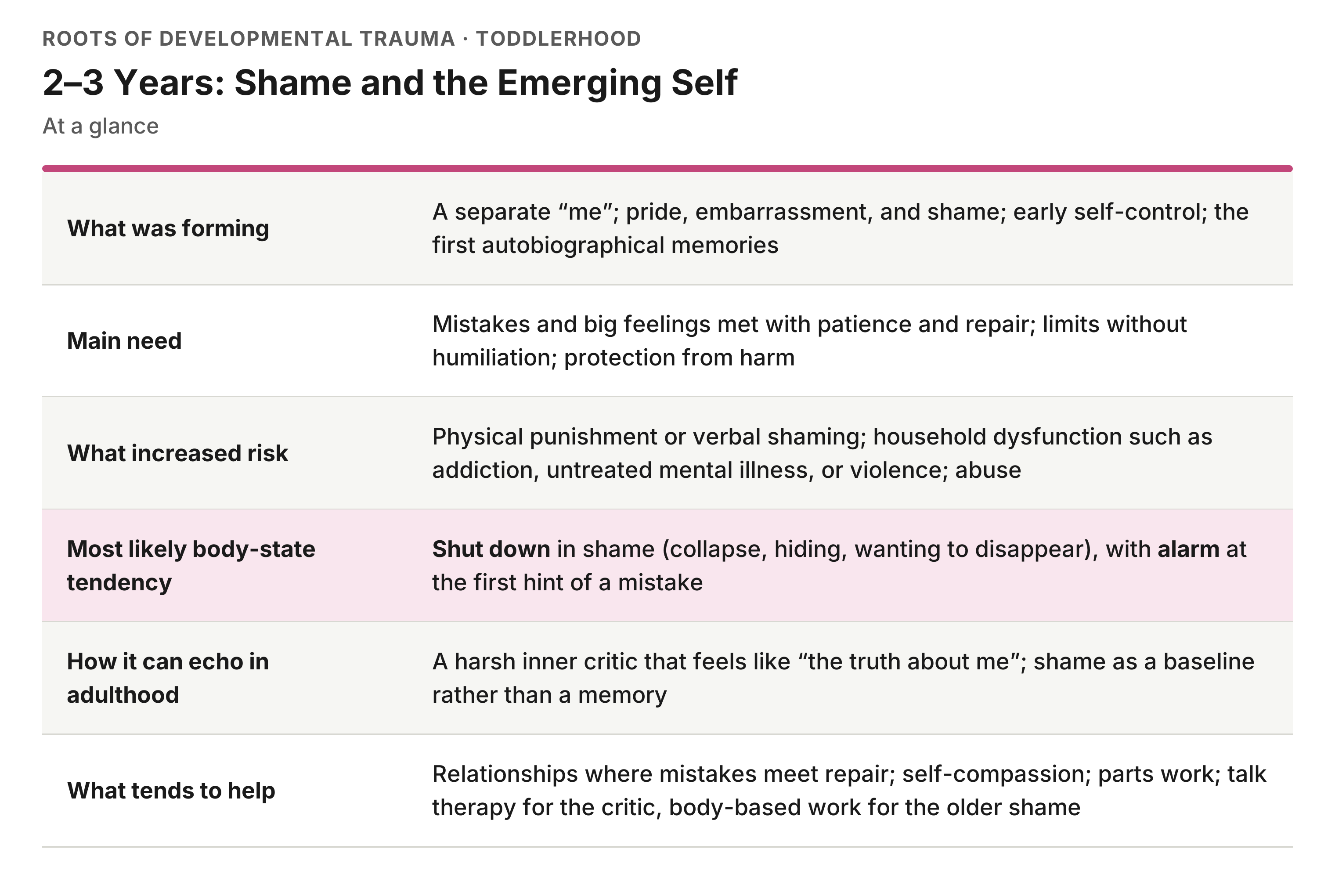
What was forming
A separate "me"
Between two and three, a child comes to understand that they are a separate person, with their own body, wants, and will. This is the age of "No!", "Mine!", and "Me do it!" Psychologist Erik Erikson described this stage as a tension between autonomy and shame and doubt. A child who is allowed to try, fail, and try again, with support, develops a sense of "I can." A child whose attempts are ridiculed or punished develops doubt about themselves.
This drive for independence is healthy and necessary. It can also be exhausting for caregivers, which is part of why this window is so tender. The very behaviors that are a child's developmental work, such as saying no, testing limits, and insisting on doing it themselves, are the ones most likely to provoke frustration.
Pride, embarrassment, and shame
Once a child recognizes themselves as a separate "me," a new family of emotions becomes possible for the first time. These are called self-conscious emotions, because they involve evaluating the self:
- Pride: "I did it!"
- Embarrassment: wanting to hide when others are looking
- Guilt: "I did something bad," which motivates making things right
- Shame: "I am bad," which motivates hiding and disappearing
Researchers draw an important line between guilt and shame. Guilt focuses on a behavior and leads toward repair. Shame focuses on the whole self and leads toward collapse. Both are learned in this window, and which one a child learns depends heavily on how the adults around them respond to mistakes.
Early self-control
Basic effortful control starts to emerge: the ability to wait, to stop an action, or to shift attention on purpose. This is an early precursor to the executive functions that will develop through adolescence. But at this age, it remains fragile and easily overwhelmed. A two-year-old can sometimes wait for a cookie and sometimes can't, especially when tired, hungry, or upset. Big feelings still regularly push a child outside their window of tolerance.
The first story of "me"
Language grows quickly, and with it comes the ability to name feelings and to talk about the past. Self-referential and autobiographical memory begins to form: the earliest "I did that" sense of self. Most adults' earliest memories date from around age three or four, so this window sits right at the edge of what can be consciously remembered.
Children build these early memories together with their caregivers. When a parent reminisces with a child ("Remember when you fell down at the park? You were scared, and then Daddy picked you up"), the child learns how to make sense of experiences, including hard ones. The stories caregivers tell about a child, and the tone they use, become the raw material for the story the child will tell about themselves.
Why this window matters
Shame becomes part of identity
In earlier windows, hard experiences were stored mostly in the body: a felt sense of safety or danger. Now, for the first time, a child has a "self" for experiences to attach to. That changes how they are recorded.
When a two- or three-year-old is shamed or harshly punished, they can't yet tell the difference between "I did something wrong" and "I am something wrong." Their thinking is too young to separate a behavior from the self. So the experience stops feeling like "something bad happened" and starts feeling like "something is wrong with me."
This is a major reason shame-based experiences at this age tend to become structural, part of identity, rather than episodic, the way a single bad memory would be. The message isn't stored as an event. It becomes part of the foundation the self is built on.
Shame in the body
Shame isn't only a thought. It is a body state. When a child feels shame, they collapse: eyes drop, shoulders curl, the face goes hot, and they want to hide or disappear. In the language of this series, shame is a form of shut down.
Brief moments of shame are a normal part of learning limits, and children recover quickly when a caregiver reconnects. The danger is shame that is frequent, intense, and never repaired. Then the collapse becomes a familiar place the nervous system keeps returning to, and the inner message that goes with it ("I'm bad") becomes a belief.
The voice becomes internal
At this age, children learn by absorbing the words, tone, and expressions of the people around them. Over time, the way a caregiver speaks to a child becomes the way the child speaks to themselves. A caregiver who says "Oops, let's try again" becomes an inner voice of patience. A caregiver who says "What's wrong with you? You never get anything right" becomes an inner critic.
This is one of the deepest roots of what is often called toxic shame: the core belief, carried into adulthood, that one is fundamentally flawed.
What increased risk looked like
Punishment and shaming for ordinary behavior
Defiance, tantrums, messes, and boundary-testing are normal and expected at this age. Risk rises when these ordinary behaviors are met with:
- Physical punishment, such as spanking, slapping, or rough handling. Research has consistently linked physical punishment with more behavior problems and poorer mental health later, not fewer.
- Verbal shaming: "Bad boy," "What's wrong with you?" "You're so stupid," "Big girls don't cry"
- Ridicule or mockery, especially of tears, fears, or failed attempts
- Humiliation in front of others
- Withdrawal of love as a consequence: coldness, silence, or "I don't love you when you act like that"
- Unrealistic expectations, such as being punished for accidents, for not sitting still, or for being unable to manage feelings no two-year-old can manage
These responses can wire shame into a child's emerging sense of self.
Household dysfunction
Exposure to household dysfunction, such as a caregiver's substance use, untreated mental illness, or intimate partner violence, lands differently at this age. A child is now verbal and aware enough to notice that something is wrong, but doesn't have the cognitive tools to make sense of it, or any ability to protect themselves.
Young children often resolve this confusion by blaming themselves. "Daddy is angry because I was bad." "Mommy is sad because of me." A child's mind would rather believe they caused the problem, and could therefore fix it, than face the far more frightening truth that the adults they depend on are not okay.
Sexual abuse
Young children can't yet reliably recognize or report unsafe touch, which leaves them fully dependent on the adults around them for protection. When sexual abuse is perpetrated by a caregiver or family member, it often begins in early childhood. Abuse at this age is especially confusing and shaming, because the child has no words for it and no way to understand it. It is never the child's fault.
If you are concerned about a child's safety now, you can call or text the Childhelp National Child Abuse Hotline at 1-800-422-4453. If you are an adult survivor, the RAINN National Sexual Assault Hotline (1-800-656-4673) offers confidential support. Both are available 24/7.
A word about caregivers
Many caregivers who shamed or punished harshly were repeating what was done to them, often believing it was the right way to raise a child. Naming the impact is not about condemning them. It is about understanding where a harsh inner voice came from, so that it can be questioned.
Echoes in adulthood
An inner critic that feels like the truth
Because shame at this age becomes structural rather than episodic, adults with disruption here often describe a harsh inner critic that feels less like a learned voice and more like "just the truth about me." It may call them stupid, lazy, worthless, or a failure over small mistakes, with a cruelty they would never direct at anyone else.
Shame may not attach to any single memory. It can simply feel like a baseline: a background sense of being defective that's always there, waiting to be confirmed.
How it can show up
- Perfectionism: working to make no mistakes, because a mistake feels like proof of being bad
- Fear of being seen: hiding, avoiding the spotlight, or dreading feedback
- Over-apologizing, or apologizing for existing
- Difficulty accepting praise, because it doesn't match the inner story
- Defensiveness or anger when criticized; for some people, shame flips quickly into rage, because anger feels safer than collapse
- Difficulty asking for help, because needing help feels like failure
- People-pleasing, to keep others from seeing the "real" flaw
- A sense of being "too much" or never enough
On the ladder
In the language of this series, a mistake or a hint of criticism can trigger alarm: a racing heart, a flush of heat, a scramble to fix or explain. If it feels like shame has been confirmed, the nervous system can drop into shut down: wanting to hide, disappear, or curl up. Many people describe a quick plunge from one to the other.
The inner critic as protector
Many therapists find it helpful to understand the inner critic as a part that once tried to protect the child. If a child could criticize themselves first, maybe they could avoid being criticized, shamed, or hurt by someone else. The critic is harsh, but its original job was safety. Seeing it this way can soften the battle with it.
The good news
A voice that was learned can be questioned. A sense of self that was shaped in relationship can be reshaped in relationship.
What helps
Then: what children needed
What protected children most in this window:
- Mistakes met with patience: "Oops! Let's clean it up together"
- Correcting the behavior, not the child: "Hitting hurts. I won't let you hit," rather than "You're a bad boy"
- Limits without humiliation: firm, consistent, and kind
- Room to try: letting a child do things themselves, even slowly or imperfectly
- Help with big feelings: staying close and naming the feeling during a meltdown
- Repair after a caregiver's mistakes: "I yelled at you, and that wasn't okay. I'm sorry"
- Warm storytelling: talking about the child's experiences, including hard ones, with understanding
- Protection: adults who kept the child safe from harm and believed them
Now: healing as an adult
Reading about a pattern is a starting point. Lasting change tends to come from something reading alone can't provide: the felt experience of a steady, attuned relationship where mistakes are met with repair instead of shame. In therapy, that can mean making a mistake, saying something you're embarrassed by, or disagreeing with your therapist, and discovering that the relationship holds.
Because this window sits at the very beginning of the narrative self, it can be reached in more than one way. Talk therapy can help put words to the inner critic, while relational and body-based work can reach the shame that feels older than words. Approaches that often help include:
- Parts work such as Internal Family Systems, which helps you get to know the inner critic, understand what it's protecting, and care for the young part that carries the shame
- Compassion-Focused Therapy, developed specifically for people with high shame and self-criticism
- Cognitive approaches that help you notice the critic's messages and question them rather than accept them as fact
- Body-based therapies that work with the physical collapse of shame and help the body find a more upright, open posture
- Attachment-focused and relational therapy, where repair after mistakes becomes a lived experience
- Trauma-focused therapy, such as EMDR, when specific abuse or traumatic experiences are part of the picture
Practices for the inner critic
- Notice whose voice it is. Ask: "Whose words are these? Who used to talk to me like this?"
- Separate the act from the self. Translate "I'm so stupid" into "I made a mistake."
- Talk to yourself as you would to a child you love. If you'd never say it to a three-year-old, it doesn't belong in your inner voice either.
- Try self-compassion. Researcher Kristin Neff describes three parts: noticing that you're suffering, remembering that everyone struggles, and offering yourself kindness.
- Feel shame in the body. When it hits, notice the collapse, and gently counter it: lift your gaze, straighten your spine, put a hand on your heart, and breathe.
- Share it with someone safe. Shame grows in hiding. Speaking it aloud to someone who responds with empathy is one of the most powerful ways to shrink it.
In practice: a composite vignette
This vignette is a composite drawn from common clinical patterns. It does not describe any real person.
David, 45, describes a running inner monologue that calls him stupid or a failure over small mistakes: a typo in an email, a wrong turn, a forgotten errand. It's a harshness he would never direct at anyone else. He is successful at work, but he double- and triple-checks everything, and praise from his boss makes him uncomfortable rather than proud. His wife says he apologizes constantly.
Between ages two and three, David was raised mainly by a caregiver who used ridicule and shaming as the main form of discipline. Spilled milk brought mockery. Tears brought "Stop being a baby." David has almost no memories from that time, but the voice in his head isn't really his own. It is a caregiver's, absorbed at an age before he had any way to tell the difference between "I did something wrong" and "I am something wrong."
In therapy, David began by simply noticing the voice and asking whose it was. The first time he recognized its tone, he felt something unexpected: sadness for the small boy who had heard those words every day. Using parts work, he came to see the critic as a part that had tried to protect him by getting to his mistakes before anyone else could. He began answering it differently: "I made a mistake. That's allowed."
The biggest shift came in the therapy room itself. When David forgot an appointment, he arrived the next week braced for disappointment. Instead, his therapist was warm and curious. That simple experience, a mistake met with repair instead of shame, was something his body had never known. The voice didn't vanish, but it grew quieter, and David found he could laugh at small mistakes for the first time.
Questions for reflection
These questions can stir up shame. Go gently, take breaks, and consider exploring them with your therapist. If difficult memories surface, you don't have to work through them alone.
- What does your inner critic say to you? Write down a few of its most common phrases.
- Whose voice does it sound like? Where might you have first heard those words or that tone?
- How were mistakes and big feelings handled in your home when you were small?
- Where do you feel shame in your body? What happens to your posture, face, and breath?
- What might your inner critic be trying to protect you from?
- What would you say to a two-year-old who spilled their milk, or cried, or said no? Can you imagine saying that to yourself?
Sources
- Erikson, E. H. (1950). Childhood and Society. W. W. Norton.
- Fivush, R., Haden, C. A., & Reese, E. (2006). Elaborating on elaborations: Role of maternal reminiscing style in cognitive and socioemotional development. Child Development, 77(6), 1568–1588.
- Gershoff, E. T., & Grogan-Kaylor, A. (2016). Spanking and child outcomes: Old controversies and new meta-analyses. Journal of Family Psychology, 30(4), 453–469.
- Gilbert, P. (2010). Compassion Focused Therapy: Distinctive Features. Routledge.
- Lewis, M. (1992). Shame: The Exposed Self. Free Press.
- Neff, K. (2011). Self-Compassion: The Proven Power of Being Kind to Yourself. William Morrow.
- Rothbart, M. K., & Bates, J. E. (2006). Temperament. In N. Eisenberg (Ed.), Handbook of Child Psychology, Vol. 3(6th ed.). Wiley.
- Schwartz, R. C. (2021). No Bad Parts. Sounds True.
- Tangney, J. P., & Dearing, R. L. (2002). Shame and Guilt. Guilford Press.

Trending Blogs


Kelly has helped me get 'unstuck' many times. I will come to see her when I just can't seem to figure 'this last bit out', and she will take me over the finish line. She is empathetic, and... Read More
After moving states & having to leave my therapist of 6 years, I cannot express enough how fortunate I am to have found someone as incredible as Kelly. From the very first session, it... Read More
I've known Kelly for several years, so when I decided to work through some issues, she was the number one choice and only therapist I knew I could trust. Talking with Kelly is easy, like... Read More
I have been seeing Kelly for individual therapy for the past two years and could not recommend her enough! She is very insightful and has helped me navigate many difficult periods in my... Read More
Kelly has exceeded my expectations and then some! She has been an incredible resource for me, helping navigate any situation I bring to her. She is extremely thoughtful in her approach,... Read More
Kelly is an incredible, empathetic, knowledgeable therapist. She creates a safe space for her clients. I have been a client of hers for 2 years now and couldn’t ask for a better therapist.... Read More
Everyone needs a Kelly. My husband and I turned to her during a time of complete crisis, and the transformation we experienced through her guidance has been life-changing. Kelly has an incredible... Read More
Looking for Premarital Counseling? Go here. Kelly was incredible.My fiancé and I took Kelly's premarital counseling program and were blown away with how well she understood our relationship... Read More