

3-5 Years: Narrative Self & Social Expansion


3–5 Years: Narrative Self and Social Expansion
Roots of Developmental Trauma · Early Childhood
Between three and five, a child can begin to hold onto memories and tell a "story" about what happened to them, a big leap forward. The world also gets bigger: preschool, friendships, and a growing awareness that other people have their own thoughts and feelings.
At a glance
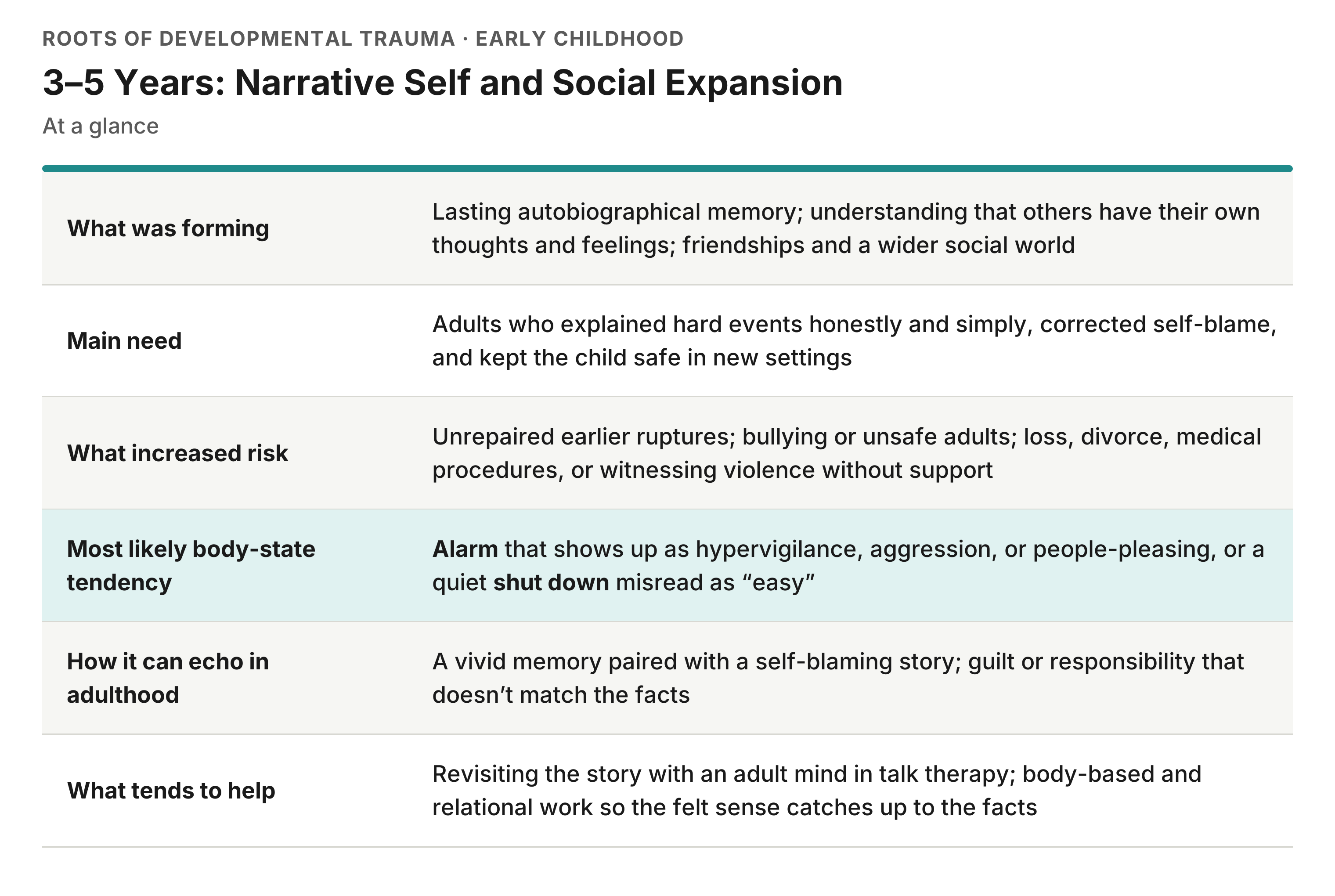
What was forming
Memories that last
By around three, the hippocampus, the brain structure that supports lasting, recallable memory, is mature enough to form autobiographical memories that can last a lifetime. This is the age most adults' earliest memories come from. Before this, experiences were stored mostly as implicit memory: feelings, body states, and expectations with no story attached. Now, for the first time, a child can hold onto what happened and tell it as a story.
These early memories are real, but they're also reconstructive. Each time a memory is recalled, it can shift a little, shaped by what the child was told, what they imagined, and how they made sense of it. A vivid memory from age four may be accurate in its feeling while being incomplete or mistaken in its details.
Other people have minds
Social brain networks are coming online. Around age four, most children develop theory of mind: the understanding that other people can have thoughts, beliefs, and feelings different from their own. A three-year-old typically assumes everyone knows what they know. A four- or five-year-old begins to understand that Mom might be sad about something that has nothing to do with them, or that a friend might believe something untrue.
This is a huge leap for empathy, friendship, and cooperation. But it is still new and wobbly, and children this age often fill gaps in their understanding with guesses that center on themselves.
Magical thinking
Preschoolers are naturally egocentric in their thinking. This doesn't mean selfish. It means they see the world as revolving around them and believe their thoughts, wishes, and behavior have powerful effects on what happens. A four-year-old may believe that being angry at a sibling made the sibling sick, or that being "good" enough could keep Daddy from leaving.
This kind of magical thinking is normal at this age. It becomes important when something bad happens, because the child's mind will tend to conclude, "I made this happen."
A bigger world
Preschool, daycare, playdates, and activities widen a child's world beyond the family. Children begin forming real friendships, navigating groups, and relating to teachers and other adults. Each of these is a chance to experience safety and belonging outside the home, and also a new source of potential hurt.
Play as language
Young children process their experiences through play. A child who saw a frightening event may play it out again and again with toys, trying to make sense of it or change the ending. Play is how children this age think, practice, and heal.
Regulation is still borrowed
True top-down emotional regulation, the ability to think your way through a strong feeling, is still years away. The prefrontal regions that support it continue maturing into early adulthood. A five-year-old can use simple strategies with help, like taking a breath or asking for a hug, but still relies heavily on adults to help them settle.
Why this window matters
The first trauma that can be remembered as a story
Because narrative memory is maturing, this is the first window in which hard experiences can be stored in something close to adult-style explicit memory. Earlier trauma tends to live in the body as sensation and state. Trauma in this window can be remembered as a story, often a vivid one.
This matters for healing. It is the first age at which more traditional, narrative-based therapy starts to gain real traction, because there is a story available to work with. Body-based work remains essential, though. The story may be explicit, but the fear, shame, and responsibility attached to it still live in the body.
The story a child tells
The most important thing about memories from this window isn't only what happened. It's the meaning the child made of it. A preschooler's mind is egocentric and magical, and their theory of mind is brand new. When something bad happens, they try to explain it with the tools they have, and those tools tend to put the child at the center:
- "Mommy and Daddy are getting divorced because I was bad."
- "Grandma died because I didn't say goodbye."
- "He hurt me because I'm a bad girl."
- "Daddy drinks because I make him angry."
These conclusions aren't foolish. They are the best a four-year-old can do. Self-blame can even feel safer than the alternative, because if I caused it, maybe I can prevent it next time. But once a child has told themselves a story like this, it can crystallize, especially if no adult gently corrects it.
What adults say, and don't say
Children this age are listening closely, and they fill silence with their own explanations. When adults don't explain a hard event, such as a divorce, a death, a hospital stay, or a parent's illness, children invent the explanation themselves. And their inventions usually center on themselves.
What increased risk looked like
Earlier wounds become visible
If earlier ruptures went unrepaired, this is often when behavioral symptoms become more visible, especially as the child enters preschool or daycare and is compared with other children. Signs that a child may be carrying more than they can manage include:
- Hypervigilance: constantly scanning adults' moods, startling easily, unable to settle
- Aggression: hitting, biting, or explosive tantrums beyond what's typical for the age
- Extreme people-pleasing: being "too good," anxious to avoid any disapproval
- A flat, shut-down affect: quiet, compliant, and withdrawn, often misread as "calm" or an "easy" child
- Regression: losing skills such as toileting, sleeping alone, or speech
- Sleep problems and nightmares
- Repetitive play that reenacts a frightening event
- Sexualized behavior that goes beyond normal curiosity for the child's age, which can be a sign of exposure to sexual content or abuse and warrants careful attention from a professional
The shut-down child is easy to miss. A preschooler who never protests, never needs anything, and sits quietly may be struggling just as much as one who is acting out.
New relational risks
Preschool and daycare introduce new relationships and new risks:
- Bullying or exclusion by peers
- Unsafe adults in childcare or other settings
- Harsh or shaming teachers or caregivers
- Repeated changes in childcare arrangements
Events that become vivid memories
Because memory consolidation is stronger now, certain experiences are more likely to be stored as vivid, explicit, narrative memories:
- Painful or frightening medical procedures or hospital stays
- Divorce or a parent leaving
- The death of a parent, sibling, grandparent, or pet
- Witnessing violence at home or in the community
- Accidents, disasters, or sudden moves
- A parent's arrest, deployment, or serious illness
The risk is greatest when these events happen without an adult who can explain them simply, comfort the child, and correct the self-blaming story the child is likely to build. As with every stage in this series, caregivers going through these events were often overwhelmed themselves, which is part of why children so often were left to make sense of things alone.
Echoes in adulthood
A story that blames the self
Adults with disruption in this window may carry a story that blames themselves for something that was never their fault. The story is often detailed and familiar, and it may have been told internally thousands of times. Common echoes include:
- Guilt that doesn't match the facts: "What could I have done differently?" about events no child could have controlled
- Over-responsibility: feeling responsible for other people's moods, choices, and happiness
- Caretaking: a habit of fixing, rescuing, or keeping the peace, often taking on an adult's role far too early
- Mind-reading: constantly scanning others' faces and tones for signs of displeasure, and assuming it's about you
- Magical thinking that lingers: a quiet sense that if you're good enough, careful enough, or vigilant enough, bad things won't happen
- Difficulty with endings: breakups, losses, or changes that reawaken an old feeling of "this is my fault"
Vivid memories, and memories with no story
This is often the earliest age from which people can recall a clear, narrative memory of a difficult event. Hard things from this age may be remembered vividly, sometimes intrusively, while earlier hard things feel more like a body sensation with no story attached. Some people notice both: a clear memory from age four, and underneath it, a vaguer, older feeling they can't explain.
Knowing versus feeling
One of the most common experiences for adults with wounds from this window is a gap between what they know and what they feel. They can explain, logically, that a four-year-old couldn't have caused a divorce or prevented a death. But the felt sense of responsibility hasn't caught up. That's because the conclusion was formed in a child's mind and stored with a child's emotions, and logic alone doesn't fully reach it.
On the ladder
In the language of this series, the self-blaming story often keeps the nervous system in a low hum of alarm: scanning, preparing, trying to prevent the next bad thing. For some people, guilt tips into shut down: heaviness, hopelessness, or a sense of being fundamentally bad.
What helps
Then: what young children needed
What protected children most in this window:
- Honest, simple explanations of hard events, matched to the child's age: "Mommy and Daddy are going to live in two houses. This is a grown-up decision. It is not because of anything you did."
- Direct correction of self-blame, often repeated many times, because children this age don't let go of their theories easily
- Permission to ask questions and to have feelings, including anger, sadness, and confusion
- Play, with an adult who was willing to join in and help the story reach a safer ending
- Consistency and routine during upheaval
- Safe adults outside the home, such as teachers, grandparents, and coaches, who noticed and cared
- Protection in new settings like preschool and daycare
When children this age receive these things, even very hard events can be integrated without leaving a lasting story of blame.
Now: healing as an adult
The good news is that a story built by a four-year-old can be revisited by an adult. Reading about a pattern is a starting point. Lasting change tends to come from something reading alone can't provide: the felt experience of a steady, attuned relationship.
Because memories from this window are often available as narrative, talk therapy can help examine and rewrite the conclusions a young child drew. Body-based and relational work can help the felt sense of responsibility finally catch up to the facts. Approaches that often help include:
- Narrative and cognitive work, which helps you look at the old story with adult eyes and write a more accurate one
- Trauma-focused therapies such as EMDR, which can help vivid memories lose their emotional charge and allow new conclusions to settle in
- Parts work such as Internal Family Systems, which lets you meet the young part that still believes it caused the harm, and offer it what it needed to hear
- Body-based therapies, to release the guilt and vigilance stored in the body
- Grief work, for losses that were never fully mourned because a child didn't have the tools
Updating the story
You might begin by gently revisiting the old story:
- Write down the story as the child understood it. What happened? Why did the child think it happened?
- Then write it again as an adult. What do you now know about what was really going on between the adults, in the family, or in the world at the time?
- Notice the gap between the two versions, without forcing yourself to feel differently right away.
- Speak to the child you were. What would you want a four-year-old in that situation to know? "It wasn't your job. It wasn't your fault. You were so small."
- Let it take time. Feelings often take longer to update than facts. Repetition, and the presence of someone safe, help them catch up.
In practice: a composite vignette
This vignette is a composite drawn from common clinical patterns. It does not describe any real person.
Ana, 33, has a detailed, vivid memory of her parents' divorce when she was four: her father carrying boxes to the car, her mother crying at the kitchen table. Alongside it, she has an equally detailed, distorted story she built at the time: that she caused the divorce by being difficult. She remembers throwing a tantrum the night before her father left, and her four-year-old mind connected the two.
No one explained what was happening. Her parents, overwhelmed by their own grief and conflict, told her only that "Daddy is going to live somewhere else now." Ana filled in the rest herself.
As an adult, Ana can recite everything that disproves her story. She knows her parents had been unhappy for years. Her mother has told her directly that it had nothing to do with her. Yet the felt sense of responsibility hasn't fully caught up to the facts. When her own relationships hit rough patches, she becomes anxious and accommodating, quietly convinced that if she's "easy" enough, no one will leave.
In therapy, Ana wrote down the story as her four-year-old self understood it, then wrote it again as the adult she is now. She noticed how small and alone that little girl had been, trying to make sense of something no child could understand. Using parts work, she imagined sitting with her four-year-old self at that kitchen table and telling her, "It wasn't you. You were just a little girl who was scared." EMDR helped the memory of her father carrying boxes lose some of its sharp edge.
The old story still visits sometimes. But Ana has begun to notice it as a story, one written by a child who deserved a better explanation, rather than the truth about who she is.
Questions for reflection
These questions may bring up clear memories from early childhood. Go gently, and consider exploring them with your therapist.
- What is one of your earliest clear memories? What feelings come with it?
- Was there a hard event in your early years, such as a loss, a move, a divorce, an illness, or something frightening? What did you understand about it at the time?
- Did anyone explain what was happening, or did you have to figure it out yourself?
- Is there a story from childhood in which you blamed yourself? What does the adult you know now that the child didn't?
- Where in your life do you take on responsibility that isn't really yours?
- If you could speak to yourself at four or five, what would you want that child to know?
Sources
- Bauer, P. J. (2007). Remembering the Times of Our Lives: Memory in Infancy and Beyond. Lawrence Erlbaum.
- Cohen, J. A., Mannarino, A. P., & Deblinger, E. (2017). Treating Trauma and Traumatic Grief in Children and Adolescents (2nd ed.). Guilford Press.
- Giedd, J. N., et al. (1999). Brain development during childhood and adolescence: A longitudinal MRI study. Nature Neuroscience, 2(10), 861–863.
- Lieberman, A. F., Ghosh Ippen, C., & Van Horn, P. (2015). Don't Hit My Mommy! A Manual for Child-Parent Psychotherapy with Young Children Exposed to Violence and Other Trauma (2nd ed.). Zero to Three.
- Piaget, J., & Inhelder, B. (1969). The Psychology of the Child. Basic Books.
- Wallerstein, J. S., & Kelly, J. B. (1980). Surviving the Breakup: How Children and Parents Cope with Divorce.Basic Books.
- Wellman, H. M., Cross, D., & Watson, J. (2001). Meta-analysis of theory-of-mind development: The truth about false belief. Child Development, 72(3), 655–684.
- Wimmer, H., & Perner, J. (1983). Beliefs about beliefs: Representation and constraining function of wrong beliefs in young children's understanding of deception. Cognition, 13(1), 103–128.

Trending Blogs


Kelly has helped me get 'unstuck' many times. I will come to see her when I just can't seem to figure 'this last bit out', and she will take me over the finish line. She is empathetic, and... Read More
After moving states & having to leave my therapist of 6 years, I cannot express enough how fortunate I am to have found someone as incredible as Kelly. From the very first session, it... Read More
I've known Kelly for several years, so when I decided to work through some issues, she was the number one choice and only therapist I knew I could trust. Talking with Kelly is easy, like... Read More
I have been seeing Kelly for individual therapy for the past two years and could not recommend her enough! She is very insightful and has helped me navigate many difficult periods in my... Read More
Kelly has exceeded my expectations and then some! She has been an incredible resource for me, helping navigate any situation I bring to her. She is extremely thoughtful in her approach,... Read More
Kelly is an incredible, empathetic, knowledgeable therapist. She creates a safe space for her clients. I have been a client of hers for 2 years now and couldn’t ask for a better therapist.... Read More
Everyone needs a Kelly. My husband and I turned to her during a time of complete crisis, and the transformation we experienced through her guidance has been life-changing. Kelly has an incredible... Read More
Looking for Premarital Counseling? Go here. Kelly was incredible.My fiancé and I took Kelly's premarital counseling program and were blown away with how well she understood our relationship... Read More